Auteur: Henk Tennekes

  • Het Ctgb stelt een beslissing over een versnelde herbeoordeling van thiacloprid en acetamiprid uit tot februari 2014

    Het Ctgb stelt een beslissing over een versnelde herbeoordeling van thiacloprid en acetamiprid uit tot februari 2014

    De stoffen acetamiprid en thiacloprid uit de neonicotinoïdengroep zijn tot op heden nog niet herbeoordeeld op het risico voor bijen. Het Ctgb stelt dat nieuwe studies waarin het effect op bijen van de individuele stoffen is onderzocht, geen directe aanleiding geven om versneld een herbeoordeling te maken. Echter, de studies waarin het effect op bijen van combinaties van stoffen is onderzocht, tonen aan dat de toxiciteit voor bijen van deze stoffen mogelijk verhoogd wordt als de stoffen in combinatie met andere gewasbeschermingsmiddelen worden toegepast. In principe wordt het potentieel effect van synergisme in risicobeoordelingen meegenomen. Bij sterke synergetische interacties is het echter mogelijk dat het risico voor bijen wordt onderschat. Het zal moeten worden onderzocht of hiervoor aanvullende maatregelen nodig zijn in de risicobeoordeling of bij het risicomanagement. Er wordt op dit moment ook onderzocht in hoeverre andere stofcombinaties synergisme vertonen. De Europese autoriteit voor voedselveiligheid EFSA zal worden gevraagd om, in samenwerking met Ctgb en andere kennisinstituten, een prioriteitenlijst van stoffen met synergistische interacties te maken die als eerste zullen worden onderzocht. Het Ctgb zal hierover met een eerste conclusie komen in februari 2014.

    De stoffen acetamiprid en thiacloprid uit de neonicotinoïdengroep zijn tot op heden nog niet herbeoordeeld op het risico voor bijen. Het Ctgb stelt dat nieuwe studies waarin het effect op bijen van de individuele stoffen is onderzocht, geen directe aanleiding geven om versneld een herbeoordeling te maken. Echter, de studies waarin het effect op bijen van combinaties van stoffen is onderzocht, tonen aan dat de toxiciteit voor bijen van deze stoffen mogelijk verhoogd wordt als de stoffen in combinatie met andere gewasbeschermingsmiddelen worden toegepast. In principe wordt het potentieel effect van synergisme in risicobeoordelingen meegenomen. Bij sterke synergetische interacties is het echter mogelijk dat het risico voor bijen wordt onderschat. Het zal moeten worden onderzocht of hiervoor aanvullende maatregelen nodig zijn in de risicobeoordeling of bij het risicomanagement. Er wordt op dit moment ook onderzocht in hoeverre andere stofcombinaties synergisme vertonen. De Europese autoriteit voor voedselveiligheid EFSA zal worden gevraagd om, in samenwerking met Ctgb en andere kennisinstituten, een prioriteitenlijst van stoffen met synergistische interacties te maken die als eerste zullen worden onderzocht. Het Ctgb zal hierover met een eerste conclusie komen in februari 2014.

    Bron: AgriHolland Nieuws, 10-10-2013
    http://www.agriholland.nl/nieuws/artikel.html?id=152695

  • Bayer-funded study claiming pesticides safe for bees questioned by regulators

    Bayer-funded study claiming pesticides safe for bees questioned by regulators

    Something is very wrong in Wellington County, Ontario – Jim Coneybeare says his bees are dying at an alarming rate.
    “It’s my livestock. It shouldn’t be dead stock,” he says. “There is a toxic environment out there that is killing our bees. It’s a severe problem.” Coneybeare believes a group of pesticides called neonicotinoids (NNIs) are killing his bees. Over the past three years, Canadian beekeepers have faced annual losses as high as 35 percent. “Let’s face it, this is an insecticide designed to kill insects, and it’s doing that. It’s killing bees,” he says. Experts say these losses are unsustainable. One-third of all food we eat – including almonds, melons, tomatoes, and cucumbers – is pollinated by bees. Beekeepers like Coneybeare just can’t keep up. While there are many factors associated with bee declines – including mites, viruses, and loss of habitat – there is mounting evidence that NNIs, such as one manufactured by Bayer CropScience called clothianidin, play an important part. When used appropriately, Bayer says its pesticide does not hurt bees. “Currently there is no science that say otherwise,” says Bayer’s Ontario research-and-development manager Luc Bourgeois about the company’s production of clothianidin. Clothianidin is used widely on corn, soya, and other crops.

    Something is very wrong in Wellington County, Ontario – Jim Coneybeare says his bees are dying at an alarming rate.
    “It’s my livestock. It shouldn’t be dead stock,” he says. “There is a toxic environment out there that is killing our bees. It’s a severe problem.” Coneybeare believes a group of pesticides called neonicotinoids (NNIs) are killing his bees. Over the past three years, Canadian beekeepers have faced annual losses as high as 35 percent. “Let’s face it, this is an insecticide designed to kill insects, and it’s doing that. It’s killing bees,” he says. Experts say these losses are unsustainable. One-third of all food we eat – including almonds, melons, tomatoes, and cucumbers – is pollinated by bees. Beekeepers like Coneybeare just can’t keep up. While there are many factors associated with bee declines – including mites, viruses, and loss of habitat – there is mounting evidence that NNIs, such as one manufactured by Bayer CropScience called clothianidin, play an important part. When used appropriately, Bayer says its pesticide does not hurt bees. “Currently there is no science that say otherwise,” says Bayer’s Ontario research-and-development manager Luc Bourgeois about the company’s production of clothianidin. Clothianidin is used widely on corn, soya, and other crops.

    But a recent petition filed with Health Canada by a coalition of environmental groups, including the David Suzuki Foundation and the Sierra Club, claim that NNIs can be dangerous for bees. They submitted evidence from 19 peer-reviewed studies that concluded NNIs manufactured by companies such as Bayer harm bees, even at low levels.

    “This is the time of year when bees should just be taking off,” says Christian Krupke, a Purdue University entomologist. Krupke believes NNIs have had a serious impact on bee health. “They should be doing fantastically well. To see hundreds of dead ones is not only strange it’s very…it’s the canary in the coal mine, so to speak. It’s a real warning that something is very wrong.”

    And regulators still don’t have all the answers about clothianidin.

    Bayer submitted a study on the long-term effects of clothianidin on bees as part of the pesticide approval process in the mid 2000s.

    Cynthia Scott-Dupree, a University of Guelph professor, was hired by Bayer to conduct a test as part of the approval process for the chemical. In her research, she set hives out in canola fields, some of which were treated with clothianidin. The results showed no long-term effect on bees from exposure to clothianidin on seed-treated canola.
    But now both Health Canada and the United States Environmental Protection Agency (EPA) have asked the company to redo the study.

    “I can’t understand why they would do that,” Scott-Dupree says. “Pressure – public pressure.”

    Health Canada says it considers many of the findings of the study invalid “because of irregularities in how it was conducted.”

    The agency says control- and test-hives were placed too close together, resulting in contamination of the controls.

    Krupke agrees. “I would say if that’s the study that is used for the basis of registration…it would be insufficient.”

    Health Canada has given Bayer until the end of 2015 to submit new research. By that time, the chemical will have been in use for more than a decade without a full understanding of its effects on bees.
    And now, critics say the new science Bayer is expected to submit may also be flawed. The company hired Scott-Dupree again to conduct a $950,000 study. She says this study is improved from the one deemed faulty by Health Canada and the EPA.

    “The first time we did it in 2005 there was some concerns about some of the results,” Scott-Dupree says. “So…we did it again and we tried to improve on all of the factors that were of concern the first time.”

    Though her second study has not yet been submitted to regulators, she says the results are similar to what she found in her first experiment.

    “We haven’t seen anything different than we did in the past. We’re not seeing massive colony losses.”

    But Krupke says the design of the new study is “outdated, simplistic and uninformative.”

    He says one of the problems is that Scott-Dupree did not start with hives and bees that were clean – with no exposure to pesticides before the experiment started.
    “If the hives aren’t clean, then everything is confounded. Then you don’t know what you’re going in with,” said Krupke. “You don’t have baseline data. How healthy were those hives? How stressed? How contaminated, if at all.”

    “They were strong colonies. They produced a lot of honey the year before,” Scott-Dupree says. “They were choice colonies for this particular study. They all went into the study of equal strength.”

    Other prominent scientists echo Krupke’s concerns.

    Dave Goulson, a British bee expert, says pre-exposure to other chemicals “could add considerable noise to the data set, potentially obscuring any treatment effect.”

    In a letter written to Health Canada in April, the Ontario Beekeepers Association urged the agency to put a moratorium on the approval of NNIs. “The preliminary results of this study, which are based on a serious flaw in the design, are not a basis for inaction on the part of regulators or policy-makers,” it added.

    Critics also worry about a potential conflict of interest, citing Scott-Dupree’s ties to the industry. In July, she co-authored a study that looked at the effects of NNIs on bees in Canada. The study was co-written with David Drexler, a recently retired director of development and licensing at Bayer.

    The paper downplayed the negative effects of NNIs, pointing out that the media had “practically ignored” bee death incidents that did not involve NNIs.

    Scott-Dupree says her study was a review of a Health Canada database and that it showed that bee deaths caused by NNIs were mostly moderate to minor incidents. “There’s a lot of insecticides out there that you should be looking at as well if you’re going to try and start blaming chemicals for these losses.”

    Scott-Dupree says that Drexler shares her views on this issue and that it is a “very balanced perspective.”

    “I’m not saying I’m for or against neonicotinoids. In that particular study I am simply presenting the data in the way it appears in reports presented by the federal government.”

    Health Canada is not expected to complete its review of clothianidin before 2018. Meanwhile, Ontario Premier Kathleen Wynne asked the federal government to expedite its review of NNIs.

    But that may be too late for many beekeepers.

    “The problem is bee keepers are finding it less and less profitable and more and more difficult to keep bees and are not necessarily willing to do it,” says Krupke. “So it’s not that we’ll have a collapse and we won’t have any bees; we won’t have beekeepers. And that is what in turn will lead to a shortage of bees, because it’s just too difficult to do the job.”
    Source: Global News, 15 October 2013

    UPDATE: 16×9 investigation into the use of a group of pesticides called neonicotinoids
  • Biocontrols and biopesticides offer a way of reducing the use of conventional chemistry, offering a “greener” and more sustainable way of protecting crops

    Biocontrols and biopesticides offer a way of reducing the use of conventional chemistry, offering a “greener” and more sustainable way of protecting crops

    In the past six months of 2012 about US$2bn (£1.25bn) was spent on acquisitions of biopesticide companies by such notable names as BASF (Becker Underwood), Syngenta (Pasteuria) and Bayer CropScience (AgraQuest). The market in 2012 was estimated to be worth $1.6 (£1bn) at grower level, however, projections estimate that by 2016 that could be in the region of $3bn (£1.9bn). Biocontrols and biopesticides offer a way of reducing the use of conventional chemistry, offering a “greener” and more sustainable way of protecting crops.

    In the past six months of 2012 about US$2bn (£1.25bn) was spent on acquisitions of biopesticide companies by such notable names as BASF (Becker Underwood), Syngenta (Pasteuria) and Bayer CropScience (AgraQuest). The market in 2012 was estimated to be worth $1.6 (£1bn) at grower level, however, projections estimate that by 2016 that could be in the region of $3bn (£1.9bn). Biocontrols and biopesticides offer a way of reducing the use of conventional chemistry, offering a “greener” and more sustainable way of protecting crops.

    As part of the spate of acquisitions, BASF took control of Becker Underwood – a firm that developed products such as Nemasys and Nemaslug.

    BASF specialty crops product manager Robert Storer says the products use various species of living parasitic nematodes to control pests such as vine weevil in strawberries and slugs in a range of crops and they are proving a success in fresh produce sectors.

    “Specialty crops are the driver, where growers are closer to the end user and have been required to be more dynamic in their crop protection practices,” he adds.

    Globally, the fruit and vegetable sector accounts for 80% of biopesticide sales and there have been a number of UK success stories.

    Loss of pesticide actives from tighter regulation, along with pressure from supermarkets and consumers with zero tolerance for residues on food has pushed many growers away from conventional chemistry and to biocontrols.

    Luke Hughes-Burton, herb-growing manager for VHB, says it would be extremely hard to supply his produce without biocontrols and biopesticides.

    Based in West Sussex, the firm is the largest supplier of fresh herbs in the UK retail market and has reduced the use of conventional chemistry in its glasshouses to minimal levels.

    “We have been successfully using biocontrols for pest control for many years and it has been a huge step forward for our business.”

    Mr Hughes-Burton is using Nemasys for sciarid fly larvae control and Nemasys C for shore fly larvae control, applying the liquid suspension – containing the nematodes – through an overhead gantry irrigator in the glasshouse.

    The nematodes then attach themselves to the larvae, killing them within days and reducing the impact from feeding and ensuring no pests make it on to the supermarket shelf.

    A higher cost is associated with biocontrols or biopesticides and although Mr Hughes-Burton concedes that they are costly on a pack-for-pack comparison with traditional chemistry, it’s not that simple.

    “If we have a large outbreak of flies it can push costs up, but with conventional insecticides you would need multiple applications and there is the risk of insecticide resistance also,” he explains.

    Fly numbers in the glasshouse are constantly monitored and peaks and troughs are identified and the level of nematodes is increased to mitigate high numbers.

    Conversely, where populations are low the supply of nematodes can be slowed to a trickle to reduce costs.

    “They are used all year round, but the peak of fly incidence is in March, so that’s when we release the greatest quantity of nematodes.”

    Mr Hughes-Burton is also using parasitic wasps to control leaf miners, mites to control thrips, lacewing larvae to predate aphids and biopesticide DiPel (Bacillus thuringiensis) for caterpillar control.

    Despite the successes VHB are having with biocontrols and biopesticides, Mr Hughes-Burton acknowledges there are challenges making it work in the wider environment.

    “The nematodes would have potential and we have successfully used Nemaslug to control slugs in outdoor chive crops, but natural predators are harder to contain,” he explains.

    The technology has to improve and biopesticide expert Bill Dunham of Dunham Trimmer – a company that specialises in bringing plant protection products to market – says those improvements are just around the corner.

    “Those improvements will see biopesticides take off into the cereal and row crop sectors, with technology such as micro-encapsulation, for example, improving the length of activity natural products have in the field,” he explains.

    However, it is in seed treatments he sees the initial growth into broad acre crops, with nematicide seed treatments already available for soya bean crops in North America.

    “In my opinion, within 5-10 years broad acre growers will start to see the benefits of biological seed treatments, foliar treatments and bio-stimulants,” he adds.

    Source: Farmers Weekly, 18 October 2013
    http://www.fwi.co.uk/articles/18/10/2013/141514/beat-glasshouse-pests-with-biopesticides.htm

  • Newly discovered chytrid fungus devastates salamander populations

    Newly discovered chytrid fungus devastates salamander populations

    A frightening disease has been ravaging amphibians across the planet. At least 350 species have been infected, two hundred of which have suffered massive population reductions or extinctions, some even occurring within the space of weeks. In 1999, a single fungal species called Batrachochytrium dendrobatidis (Bd), commonly known as the chytrid fungus, was identified as the causative agent for these rapid die-offs. This facilitated preemptive testing of rare or endangered amphibian populations for Bd, the early detection of which allowed scientists to establish captive breeding populations to stem amphibian species extinctions. Frighteningly, despite this discovery, there remain perplexing instances of rapid amphibian deaths that do not test positive for Bd. An Martel of Ghent University, in the journal PNAS, has recently reported a possible explanation for these mysterious deaths. Together with an international team of scientists, she has identified a second culprit: a new chytrid species named Batrachochytrium salamandrivorans (Bs), which can be translated to “the salamander-eating fungus.”


    Fire salamanders (Salamandra salamandra) are captivating creatures, jet black with vibrant yellow patterns that vary from spots to stripes. One of the last surviving populations of this species is found in Bunderbos in the southern Netherlands. In 2010, when the salamanders here first began to die, herpetologists barely had time to react before sightings dropped from 200 to 4 in one year. By 2012, nearly 96% of all salamanders present when assessed in 1997 were gone. Although currently listed as Least Concern by the IUCN Red List, fire salamanders are threatened in many parts of their range across Europe. While they have suffered greatly from habitat loss through the drying up of streams, nothing decimated their populations like this mysterious disease. Fearing the worst, scientists captured 39 individuals to establish a breeding program, only for 19 animals (nearly half) to promptly die in captivity. Post-mortems were conducted on these animals, and they were tested for Bd and a host of other amphibian diseases, but to no avail. However, further experimentation by Martel and colleagues then revealed the presence of a fungal chytrid species called Bs, closely related to Bd but previously unknown to science. It is the only chytrid species, other than Bd, known to prey on invertebrates.

    “The discovery of Batrachochytrium salamandrivorans (Bs) is very significant because it is a new species of a deadly amphibian pathogen and was undetectable using previous methods. Its discovery suggests that this, or other undescribed Batrachiochytrium species could be responsible for amphibian declines, but we have been missing them using current detection methods,” explains Brian Gratwicke, a conservation biologist at the Smithsonian Zoo in charge of efforts to stem global declining amphibian populations.

    Martel and colleagues have developed a sensitive DNA test for this new strain, which can detect Bs in swabs of the lesions of infected individuals. Remarkably, when Bs was used to infect midwife toads (which are the most sensitive of all European amphibian species to Bd), they did not contract the disease at all. Such variability lends hope that Bs will be restricted to the fire salamanders, but if it is anything like Bd, this could be wishful thinking. Martel strongly advises that all amphibian monitoring programs test for Bs, and other scientists agree.

    “There are several unexplained declines of amphibians that have not been connected to Bd,” Gratwicke told mongabay.com. “In one case, we are examining the effects of climate change as a possible factor explaining current declines of hellbenders and other salamanders in the Eastern United States. It would certainly be interesting to do some prospecting in this region for Bs and other Batrachochytrium species. Our pathologists have always advocated that we should continue to examine histopathology in enigmatic decline situations, rather than relying solely on swab results. This study is a great example of why we should always heed their advice.”

    The future of fire salamanders isn’t entirely bleak. In 2000, the Smithsonian National Zoo pioneered a treatment for amphibians infected with Bd – a series of baths in the antifungal drug, itraconazole. Martel and colleagues have used a similar drug, voriconazole, to successfully treat fire salamanders with Bs infections. Although this cure exists, researchers have shown that surviving an infection of Bd does not render an amphibian immune to subsequent exposures to the same disease. Not only does this rule out a vaccine for the disease, but it also means the source of the fungus will have to be eradicated before reintroduction programs of the fire salamanders can begin.

    Martel also reports that Bs survives at much lower temperatures than Bd, from 10 to 15 degrees Celsius, which suggests that tropical amphibian populations might not be at risk of encountering this new chytrid. In fact, heat has been suggested as a potential solution to Bd infections, since frogs with warmer body temperatures (from residing in warmer streams, or spending more time sunning) are less likely to become infected.

    While it is tempting to think that a nice hot bath will save the fire salamanders, habitat destruction and climate change remain the largest killers of amphibians the world over. The present critical condition of nearly half of all amphibians worldwide is further threatened by chytrid fungal species, due to their ability to rapidly decimate amphibian populations already teetering on the brink of extinction.

    Read more at http://news.mongabay.com/2013/0919-watsa-chytrid-fungus-devastates-salamanders.html#9HvxBIktcQsikli2.99

  • De chronologie van een crisis in de risico analyse van gewasbeschermingsmiddelen

    De chronologie van een crisis in de risico analyse van gewasbeschermingsmiddelen

    Sinds midden jaren 90 zijn insecticiden op basis van neonicotinoïden toegelaten in Nederland. Neonicotinoïden bestrijden schadelijke insecten door werking op het zenuwstelsel van insecten. En vriend en vijand zijn het erover eens: daar zijn deze middelen zeer succesvol in. In januari 2009 biedt bijenonderzoeker Tjeerd Blacquière van Universiteit Wageningen een rapport aan aan minister Gerda Verburg van Landbouw. Hij maakt zich zorgen over de sterfte van bijen: ‘Sinds 2000 sterven bijen massaal. Onze voedselvoorziening kan daardoor in gevaar komen, omdat onze voedselproductie voor een groot deel afhankelijk is van de bestuiving door honingbijen.’ Imkers kennen het fenomeen dat bijenvolken sterven. Gemiddeld sterft 5 tot 10 procent van de bijenvolken in de winter. De afgelopen jaren lag dat percentage tussen de 25 en 30 procent. De voorlopige cijfers over de winter van 2012/2013 spreken van een wintersterfte van 15%. Blacquière wijt de sterfte aan de varroamijt. Bijenkundige Romeé van der Zee denkt dat Nosema ceranea, een soort schimmel, de boosdoener is. Een andere oorzaak van de afname van de bijenvolken is de vergrijzing van de imkers. In mei van dit jaar brengen de onderzoekers Jeroen van der Sluijs en Henk Tennekes met een brief in de wetenschapsbijlage van de NRC een nationale discussie over de rol van neonicotinoïden bij bijensterfte op gang. In november 2009 wordt een door meer dan 40.000 burgers ondertekende petitie voor een moratorium op neonicotinoïden overhandigd aan de Tweede Kamer. De initiatiefnemer hiervan is de Noord-Hollandse natuurbeschermer Jaap Molenaar. In juli 2010 publiceert de Nederlandse toxicoloog Henk Tennekes een artikel in het vaktijdschrift Toxicology waaruit blijkt dat de giftigheid van de neonicotinoïden imidacloprid en thiacloprid voor geleedpotigen – waaronder bijen – vooral op de lange termijn behoorlijk is onderschat. Volgens Tennekes zijn de minieme hoeveelheden die in stuifmeel en nectar gevonden worden voldoende om bij langdurige blootstelling de ondergang van bijenvolken te bewerkstelligen. Bayer bestrijdt dit. In november 2010 publiceert Tennekes het boek ‘Disaster in the Making’. Daarin waarschuwt hij voor een mogelijke – door neonicotinoïden veroorzaakte – uitroeiing van ongewervelde dieren en een breuk in de voedselketen. In de 2013 gepubliceerde literatuurstudie van Tjeerd Blacquiere et al., die ook aan de Tweede Kamer is aangeboden, wordt vastgesteld dat de NOEL (no-observable-effect-level) van imidacloprid voor bijen bij 20 ppb ligt, maar de ontdekking van Tennekes toont aan dat zelfs een 100-voudig geringere concentratie (0, 2 ppb) nog sterfte binnen de levensverwachting van honingbijen veroorzaakt. De werkelijke risico’s worden in Blacquiere’s literatuurstudie dus schromelijk onderschat.

    Sinds midden jaren 90 zijn insecticiden op basis van neonicotinoïden toegelaten in Nederland. Neonicotinoïden bestrijden schadelijke insecten door werking op het zenuwstelsel van insecten. En vriend en vijand zijn het erover eens: daar zijn deze middelen zeer succesvol in. In januari 2009 biedt bijenonderzoeker Tjeerd Blacquière van Universiteit Wageningen een rapport aan aan minister Gerda Verburg van Landbouw. Hij maakt zich zorgen over de sterfte van bijen: ‘Sinds 2000 sterven bijen massaal. Onze voedselvoorziening kan daardoor in gevaar komen, omdat onze voedselproductie voor een groot deel afhankelijk is van de bestuiving door honingbijen.’ Imkers kennen het fenomeen dat bijenvolken sterven. Gemiddeld sterft 5 tot 10 procent van de bijenvolken in de winter. De afgelopen jaren lag dat percentage tussen de 25 en 30 procent. De voorlopige cijfers over de winter van 2012/2013 spreken van een wintersterfte van 15%. Blacquière wijt de sterfte aan de varroamijt. Bijenkundige Romeé van der Zee denkt dat Nosema ceranea, een soort schimmel, de boosdoener is. Een andere oorzaak van de afname van de bijenvolken is de vergrijzing van de imkers. In mei van dit jaar brengen de onderzoekers Jeroen van der Sluijs en Henk Tennekes met een brief in de wetenschapsbijlage van de NRC een nationale discussie over de rol van neonicotinoïden bij bijensterfte op gang. In november 2009 wordt een door meer dan 40.000 burgers ondertekende petitie voor een moratorium op neonicotinoïden overhandigd aan de Tweede Kamer. De initiatiefnemer hiervan is de Noord-Hollandse natuurbeschermer Jaap Molenaar. In juli 2010 publiceert de Nederlandse toxicoloog Henk Tennekes een artikel in het vaktijdschrift Toxicology waaruit blijkt dat de giftigheid van de neonicotinoïden imidacloprid en thiacloprid voor geleedpotigen – waaronder bijen – vooral op de lange termijn behoorlijk is onderschat. Volgens Tennekes zijn de minieme hoeveelheden die in stuifmeel en nectar gevonden worden voldoende om bij langdurige blootstelling de ondergang van bijenvolken te bewerkstelligen. Bayer bestrijdt dit. In november 2010 publiceert Tennekes het boek ‘Disaster in the Making’. Daarin waarschuwt hij voor een mogelijke – door neonicotinoïden veroorzaakte – uitroeiing van ongewervelde dieren en een breuk in de voedselketen. In de 2013 gepubliceerde literatuurstudie van Tjeerd Blacquiere et al., die ook aan de Tweede Kamer is aangeboden, wordt vastgesteld dat de NOEL (no-observable-effect-level) van imidacloprid voor bijen bij 20 ppb ligt, maar de ontdekking van Tennekes toont aan dat zelfs een 100-voudig geringere concentratie (0, 2 ppb) nog sterfte binnen de levensverwachting van honingbijen veroorzaakt. De werkelijke risico’s worden in Blacquiere’s literatuurstudie dus schromelijk onderschat.

    Verder lezen in:
    Auteur: Broer de Boer, september 2013
    Neo’s: moratorium of mortuarium?
    Gaat verbod neonicotinoïdengebruik om meer dan voorkomen bijensterfte?
    http://www.greenkeeper.nl/artikel.asp?id=9-4079

  • Beyond the birds and the bees

    Beyond the birds and the bees

    Beyond the Birds and the Bees moves the spotlight from the risks neonicotinoids pose to bees to the impacts of neonicotinoids to invertebrates such as earthworms or lady beetles. The report provides a comprehensive review of published articles and pulls together the growing body of research that demonstrates risks from neonicotinoids to these beneficial insects. These risks occur particularly in agricultural systems, but are also found in urban and suburban ornamental landscapes. This report details potential negative impacts of neonicotinoid insecticides on important beneficial insects. It also makes recommendations on how we can better protect important beneficials like beetles and wasps.

    Beyond the Birds and the Bees moves the spotlight from the risks neonicotinoids pose to bees to the impacts of neonicotinoids to invertebrates such as earthworms or lady beetles. The report provides a comprehensive review of published articles and pulls together the growing body of research that demonstrates risks from neonicotinoids to these beneficial insects. These risks occur particularly in agricultural systems, but are also found in urban and suburban ornamental landscapes. This report details potential negative impacts of neonicotinoid insecticides on important beneficial insects. It also makes recommendations on how we can better protect important beneficials like beetles and wasps.

    Source: The Xerces Society
    http://www.xerces.org/beyond-the-birds-and-the-bees/

  • Fipronil to blame for massive bee deaths in Minnesota

    Fipronil to blame for massive bee deaths in Minnesota

    A recent investigation into the death of thousands of bees last month in Minnesota revealed that fipronil, a widely used insecticide, was to blame. In mid-September, three colonies of bees in Minneapolis were found twitching and dying on the ground. Local apiarist Mark Lucas paints a grim picture of the poisoning event, which he witnessed, recalling that bees inside the hive came “spilling out of the hive as if they were drunk.” University of Minnesota Bee Lab, the University’s Bee Squad and the Minnesota Department of Agriculture (MDA) carried out the investigation, taking samples from hives to confirm pesticide poisoning. Indeed, MDA tests found that all three of the affected hives tested positive for the presence of fipronil.

    A recent investigation into the death of thousands of bees last month in Minnesota revealed that fipronil, a widely used insecticide, was to blame. In mid-September, three colonies of bees in Minneapolis were found twitching and dying on the ground. Local apiarist Mark Lucas paints a grim picture of the poisoning event, which he witnessed, recalling that bees inside the hive came “spilling out of the hive as if they were drunk.” University of Minnesota Bee Lab, the University’s Bee Squad and the Minnesota Department of Agriculture (MDA) carried out the investigation, taking samples from hives to confirm pesticide poisoning. Indeed, MDA tests found that all three of the affected hives tested positive for the presence of fipronil.

    Although neonicotinoid pesticides such as clothianidin, thiamethoxam and imidacloprid have been widely implicated in the phenomenon of colony collapse disorder (CCD), other pesticides are known to adversely affect honey bee health. Fipronil has also been heavily implicated in elevated bee toxicity and decline. Indeed, the European Union (EU) recently put forth a proposal to restrict the use of the pesticide in recognition of the high acute risks it poses to bees.

    The chemical is widely used for indoor and turf pest control in the U.S., incorporated in more than 50 pest-killing products and is highly toxic. Fipronil has been shown to reduce behavioral function and learning performances in honey bees. A 2011 French study reported that newly emerged honey bees exposed to low doses of fipronil and thiacloprid succumbed more readily to the parasite Nosema ceranae compared to healthy bees, supporting the hypothesis that the synergistic combination of parasitic infection and high pesticide exposures in beehives may contribute to colony decline. An extensive overview of the major studies showing the effects of pesticides on pollinator health can be found on Beyond Pesticides’ What the Science Shows webpage.

    The MDA’s report posited that the bee kill incident was likely started by a neighborhood individual who sprayed fipronil along the boundaries of a building and onto nearby flowers visited by bees. Once exposed, those bees flew back to their hives, inadvertently exposing the entire colony. It is unknown who exactly sprayed the pesticide, and the MDA report indicated that it will not investigate further into the identity of the applicator.

    Pesticide-related bee-deaths have become a recurring story across the nation. In June 2013 an estimated 50,000 bumblebees were found dead or dying in a shopping mall in Wilsonville, OR, due to a tree application of the neonicotinoid insecticide dinotefuran. Then in July 2013, 37 million honeybees were reported dead across a single farm in Ontario from the dust associated with planting neonic-treated corn seeds, prompting Health Canada to release new measures intended to protect bees from further exposure to neonicotinoids. That same month, the EU put forward a proposal to restrict the use of fipronil. This proposal came on the heels of an EU-wide decision to restrict the use of three pesticides that belong to the neonicotinoid family—imidacloprid, clothianidin and thiamethoxam, which will come into force on December 1.

    Meanwhile, the U.S. Environmental Protection Agency (EPA) has failed to act quickly to protect pollinators. In response to inaction, Beyond Pesticides, joined beekeepers, environmental and consumer groups in filing a lawsuit in Federal District Court against the EPA for its failure to protect pollinators from dangerous pesticides. The coalition seeks suspension of the registrations of insecticides—clothianidin and thiamethoxam—which have repeatedly been identified as highly toxic to honey bees, clear causes of major bee kills and significant contributors to the devastating ongoing mortality of bees known as CCD. The suit challenges the EPA’s oversight of these bee-killing pesticides, as well as the agency’s practice of “conditional registration” and labeling deficiencies.

    With one in three bites of food reliant on bees and other beneficial species for pollination, the decline of these important species demands swift action. The mounting scientific evidence, along with unprecedented annual colony losses at 30 to 90 percent this year, demonstrates the impacts that these pesticides are having on these fragile beings.

    Source: EcoWatch, 10 October 2013
    http://ecowatch.com/2013/pesticides-to-blame-for-massive-bee-deaths/

  • Scottish seabird numbers continue to decline

    Scottish seabird numbers continue to decline

    SEABIRD numbers are continuing to dwindle according to a new report which has sparked renewed calls for action to avoid internationally important species vanishing from Scotland’s coasts. Figures from Scottish Natural Heritage (SNH) show a continuing downward trend in the number of seabirds nesting on Scottish shores, with numbers falling by almost half (46 per cent) since the 1980s and eight per cent in the past five years. Counts carried out across the country found nine of the 11 species studied since 1986 have shown a marked decline, with the Arctic skua suffering the most severe drop. Populations of the bird were last year at their lowest since the study began, showing an overall drop of 80 per cent and a five per cent drop between 2011 and 2012. The Arctic tern and black-legged kittiwake have also experienced marked declines, with numbers dropping by 72 per cent and 68 per cent respectively. Only two species, the black guillemot and common gull, were shown to have stable populations. Conservationists say the updated report confirms their “worst fears” and urgent steps must be taken to halt the seabirds’ decline.

    SEABIRD numbers are continuing to dwindle according to a new report which has sparked renewed calls for action to avoid internationally important species vanishing from Scotland’s coasts. Figures from Scottish Natural Heritage (SNH) show a continuing downward trend in the number of seabirds nesting on Scottish shores, with numbers falling by almost half (46 per cent) since the 1980s and eight per cent in the past five years. Counts carried out across the country found nine of the 11 species studied since 1986 have shown a marked decline, with the Arctic skua suffering the most severe drop. Populations of the bird were last year at their lowest since the study began, showing an overall drop of 80 per cent and a five per cent drop between 2011 and 2012. The Arctic tern and black-legged kittiwake have also experienced marked declines, with numbers dropping by 72 per cent and 68 per cent respectively. Only two species, the black guillemot and common gull, were shown to have stable populations. Conservationists say the updated report confirms their “worst fears” and urgent steps must be taken to halt the seabirds’ decline.

    Alex Kinninmonth, living seas policy officer for the Scottish Wildlife Trust, said: “The alarm bells have been ringing for the last decade or more, and the seabird monitoring report … really just confirms our worst fears that seabirds continue to suffer from changes in Scottish coastal waters.

    “There are no more excuses for inaction, the powers are available to create protected areas at sea that safeguard key habitats for sand eels, a key prey item for many of our seabirds, like kittiwake.”

    Allan Whyte, marine policy officer at RSPB Scotland, said: “These figures from SNH add to the mountain of evidence indicating that Scotland’s iconic seabirds are in desperate need of proper protection. RSPB Scotland has been calling on the Scottish Government to designate MPAs for seabirds for the best part of a decade.”

    The majority of the UK’s seabirds – about four million of 24 species – nest around Scotland’s coasts. The recent drop in numbers follows two decades with occasional years of poor breeding, but the trend has happened more often and more markedly since the last official seabird census in 2000.

    The most serious declines have been seen in Orkney and Shetland.
    Source: The Scotsman, 11 October 2013
    http://www.scotsman.com/news/environment/scottish-seabird-numbers-continue-to-decline-1-3136733

  • Deutsche Unternehmen verfügen über mehr Genpatente auf Pflanzen als die US-Firma Monsanto

    Deutsche Unternehmen verfügen über mehr Genpatente auf Pflanzen als die US-Firma Monsanto

    Deutsche Konzerne haben vom Europäischen Patentamt mehr Patente auf gentechnisch veränderte Pflanzen erhalten als ihr Konkurrent Monsanto aus den USA. Das zeigt eine Auswertung aller rund 2.000 Schutzrechte auf transgene Pflanzen, die das Amt in den vergangenen 20 Jahren erteilt hat. Sie wurde von den Initiativen „Kein Patent auf Leben!“ und „Coordination gegen Bayer-Gefahren“ erstellt und lag der taz vorab vor. Der Leverkusener Chemiekonzern Bayer besitzt demnach 206 Patente auf Gentech-Pflanzen wie Mais, Weizen oder Bäume. Das US-Unternehmen Pioneer steht mit 179 Schutzrechten auf Platz zwei – gefolgt von der Ludwigshafener BASF mit 144. Monsanto steht nur auf Rang fünf mit 119 Patenten, hinter der Schweizer Syngenta mit 135 Schutzrechten.

    Deutsche Konzerne haben vom Europäischen Patentamt mehr Patente auf gentechnisch veränderte Pflanzen erhalten als ihr Konkurrent Monsanto aus den USA. Das zeigt eine Auswertung aller rund 2.000 Schutzrechte auf transgene Pflanzen, die das Amt in den vergangenen 20 Jahren erteilt hat. Sie wurde von den Initiativen „Kein Patent auf Leben!“ und „Coordination gegen Bayer-Gefahren“ erstellt und lag der taz vorab vor. Der Leverkusener Chemiekonzern Bayer besitzt demnach 206 Patente auf Gentech-Pflanzen wie Mais, Weizen oder Bäume. Das US-Unternehmen Pioneer steht mit 179 Schutzrechten auf Platz zwei – gefolgt von der Ludwigshafener BASF mit 144. Monsanto steht nur auf Rang fünf mit 119 Patenten, hinter der Schweizer Syngenta mit 135 Schutzrechten.

    „In der Diskussion um gentechnisch verändertes Saatgut dominiert die Kritik an der Geschäftstätigkeit von Monsanto. Dabei ist das Gentechnik-Programm von Bayer kaum weniger gefährlich sagt Philipp Mimkes von der Coordination gegen Bayer-Gefahren. Das von Bayer entwickelte Pestizid Glufosinat, das in Kombination mit Gentech-Saatgut angeboten wird, sei als reproduktionstoxisch klassifiziert und solle in der EU 2017 vom Markt genommen werden. Allein 23 Patente des Konzerns bezögen sich auf Resistenzen von Pflanzen gegen Unkrautvernichtungsmittel. Die Position der deutschen Firmen im Windschatten von Monsanto bezeichnet Mimkes als „komfortabel“, „da die Unternehmen kaum einer öffentlichen Diskussion ausgesetzt sind“.

    Ruth Tippe von „Kein Patent auf Leben!“ wies daraufhin, dass auch Bayer und BASF zu den zehn größten Agro-Unternehmen gehörten, die schon heute einen Marktanteil von mehr 70 Prozent bei Saatgut und Pestiziden hätten. „Ziel dieses Oligopols ist es, den Markt unter sich aufzuteilen und letztlich die Ernährungsgrundlagen der Menschheit zu kontrollieren. Patente auf Pflanzen und Tiere sind dabei ein zentrales Hilfsmittel“, erklärte Tippe. Patentgeschützte Lebewesen dürfen nur weitergezüchtet werden, wenn die Hersteller einverstanden sind.

    Quelle: TAZ,10.10.2013
    http://www.taz.de/1/archiv/digitaz/artikel/?ressort=wu&dig=2013%2F10%2F10%2Fa0083&cHash=4b1da4024ab227ef09b36d15762b24fb

  • De blauwe kiekendief is zo goed als verdwenen uit de duingebieden op de Nederlandse Waddeneilanden

    De blauwe kiekendief is zo goed als verdwenen uit de duingebieden op de Nederlandse Waddeneilanden

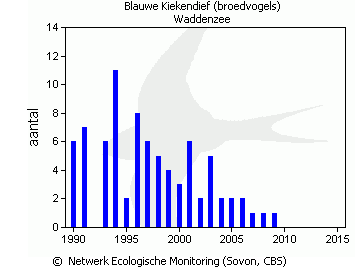
    Decennia lang waren de duingebieden op de Nederlandse Waddeneilanden de belangrijkste bolwerken voor de blauwe kiekendief (Circus cyaneus). De laatste jaren nemen hun aantallen echter sterk af. Uit een geïntegreerd populatiemodel komt naar voren dat voedseltekort wel eens de hoofdoorzaak van deze achteruitgang kan zijn. In de jaren negentig was de in vlakke v-vorm boven het duingebied zwevende blauwe kiekendief een bekende verschijning op de Waddeneilanden. Ruim 90% van de Nederlandse broedpopulatie (110-120 paar) nestelde toen in de duingebieden van de eilanden. In 1940 werd het eerste broedpaar op Ameland gesignaleerd en in 1946 volgde Terschelling. Vanuit deze twee eilanden zijn waarschijnlijk ook de andere Nederlandse en Duitse eilanden door de blauwe kiekendief gekoloniseerd. Maar na de jaren negentig nam het aantal broedgevallen sterk af. In 2000 broedden nog 70 paren op de Nederlandse eilanden. In 2012 waren daar nog 11 van over. Op Ameland broeden al vier achtereenvolgende jaren geen blauwe kiekendieven meer. Alleen op Texel kunnen we deze karakteristieke roofvogel nog af en toe tegenkomen.

    Decennia lang waren de duingebieden op de Nederlandse Waddeneilanden de belangrijkste bolwerken voor de blauwe kiekendief (Circus cyaneus). De laatste jaren nemen hun aantallen echter sterk af. Uit een geïntegreerd populatiemodel komt naar voren dat voedseltekort wel eens de hoofdoorzaak van deze achteruitgang kan zijn. In de jaren negentig was de in vlakke v-vorm boven het duingebied zwevende blauwe kiekendief een bekende verschijning op de Waddeneilanden. Ruim 90% van de Nederlandse broedpopulatie (110-120 paar) nestelde toen in de duingebieden van de eilanden. In 1940 werd het eerste broedpaar op Ameland gesignaleerd en in 1946 volgde Terschelling. Vanuit deze twee eilanden zijn waarschijnlijk ook de andere Nederlandse en Duitse eilanden door de blauwe kiekendief gekoloniseerd. Maar na de jaren negentig nam het aantal broedgevallen sterk af. In 2000 broedden nog 70 paren op de Nederlandse eilanden. In 2012 waren daar nog 11 van over. Op Ameland broeden al vier achtereenvolgende jaren geen blauwe kiekendieven meer. Alleen op Texel kunnen we deze karakteristieke roofvogel nog af en toe tegenkomen.

    Bronnen: Waddenvereniging, 12 september 2013
    http://www.waddenvereniging.nl/wadweten/?item_id=7273
    De gegevens in het plaatje zijn afkomstig van het Netwerk Ecologische Monitoring (SOVON, CBS), www.sovon.nl