Auteur: Henk Tennekes

  • Viren raffen Frösche und Salamander dahin

    Viren raffen Frösche und Salamander dahin

    In Nordspanien tötet eine Gruppe nah verwandter Viren unzählige Amphibien. Die zu den Ranaviren gehörenden Erreger befallen unter anderem Frösche, Kröten und Salamander. Sie verursachen regelrechte Massensterben. Am schlimmsten betroffen seien die Geburtshelferkröte, die Erdkröte sowie der Bergmolch, berichten Wissenschaftler im Fachblatt „Current Biology“. Besorgniserregend sei, dass einzelne Virentypen aus der Gruppe mehrere unterschiedliche Arten von Amphibien befallen. Dies könne katastrophale Folgen für die Amphibien-Gemeinschaften und ihre Ökosysteme haben. Zur Gattung Ranavirus gehören mehrere Arten von Viren. Sie infizieren Fische und Reptilien, sind aber vor allem als tödliche Gefahr für Amphibien in Amerika, Europa, Asien und Australien bekannt. Die Forscher um Stephen Price von der Zoological Society of London hatten die Entwicklung der Amphibien-Populationen vor allem im Picos de Europa-Nationalpark in Nordspanien verfolgt. Nachdem sie im Jahr 2005 erstmals ein Massensterben aufgrund einer Ranavirus-Infektion festgestellt hatten, begannen sie den Bestand von sechs Arten von Amphibien einmal jährlich an unterschiedlichen Orten im Nationalpark zu überwachen.

    In Nordspanien tötet eine Gruppe nah verwandter Viren unzählige Amphibien. Die zu den Ranaviren gehörenden Erreger befallen unter anderem Frösche, Kröten und Salamander. Sie verursachen regelrechte Massensterben. Am schlimmsten betroffen seien die Geburtshelferkröte, die Erdkröte sowie der Bergmolch, berichten Wissenschaftler im Fachblatt „Current Biology“. Besorgniserregend sei, dass einzelne Virentypen aus der Gruppe mehrere unterschiedliche Arten von Amphibien befallen. Dies könne katastrophale Folgen für die Amphibien-Gemeinschaften und ihre Ökosysteme haben. Zur Gattung Ranavirus gehören mehrere Arten von Viren. Sie infizieren Fische und Reptilien, sind aber vor allem als tödliche Gefahr für Amphibien in Amerika, Europa, Asien und Australien bekannt. Die Forscher um Stephen Price von der Zoological Society of London hatten die Entwicklung der Amphibien-Populationen vor allem im Picos de Europa-Nationalpark in Nordspanien verfolgt. Nachdem sie im Jahr 2005 erstmals ein Massensterben aufgrund einer Ranavirus-Infektion festgestellt hatten, begannen sie den Bestand von sechs Arten von Amphibien einmal jährlich an unterschiedlichen Orten im Nationalpark zu überwachen.

    Die Wissenschaftler fanden bei ihren Expeditionen regelmäßig kranke und verstorbene Tiere aller Altersklassen und von allen sechs untersuchten Arten. Genetische Analysen ergaben, dass alle betroffenen Tiere mit einem Ranavirus infiziert waren, meist mit dem „Common midwife toad virus“, kurz CMTV. Die Forscher glauben, dass dieses Virus ein einziges Mal in den Park gelangte – womöglich im Gefolge des Menschen – und sich dann ausbreitete.
    In Galizien, 200 Kilometer weiter westlich, fanden die Forscher ein weiteres, sehr nah verwandtes Ranavirus, genannt Bosca’s newt virus (BNV). Es befiel dort unter anderem zwei Arten von Schwanzlurchen. Ein drittes festgestelltes Virus aus der Gruppe der Ranaviren zeigte sich weniger aggressiv.
    Einige infizierte Arten könnten aussterben
    „Die Fähigkeit dieser Viren, verschiedene Arten zu infizieren, beinhaltet die Möglichkeit, dass einige dieser Arten infolge der Infektion aussterben“, wird der Erstautor Stephen Price in einer Mitteilung zur Studie zitiert. „Krankheitserreger, die mehr als einen Wirt befallen können, sind in der Lage, sich zu erhalten, selbst wenn die Zahl eines ihrer Wirte abnimmt oder dieser ganz verschwindet. Denn es gibt ja noch weitere empfängliche Wirte.“
    Amphibien sind in vielen Regionen der Welt bedroht, seit einigen Jahrzehnten wird ein regelrechtes Amphibiensterben festgestellt. Die Ursache hierfür ist vermutlich unter anderem die Ausbreitung des sogenannten Chytridpilzes (Batrachochytrium dendrobatidis), der die Amphibien befällt und die Schutzfunktion ihrer Haut beeinträchtigt.
    Amphibien sind weltweit gefährdet
    Vermutlich tragen aber noch andere Faktoren dazu bei, wie die Verkleinerung und Zerstörung der Lebensräume von Amphibien, Pestizide aus der Landwirtschaft und der Klimawandel. In Deutschland steht laut Umweltbundesamt (UBA) mehr als die Hälfte der Frösche, Kröten und Molche auf der Roten Liste gefährdeter Tierarten. Amphibien gelten als weltweit am stärksten gefährdete Wirbeltiere.
    Quelle: Focus, 18.10.2014
    http://www.focus.de/wissen/videos/infektion-mit-katastrophalen-folgen-viren-raffen-froesche-und-salamander-dahin_id_4211186.html

    Textquelle: dpa

  • Brutvogel-Bestand in Deutschland nimmt ab

    Brutvogel-Bestand in Deutschland nimmt ab

    Jede dritte in Deutschland brütende Vogelart verzeichnet einen Rückgang ihrer Bestände. Das ist das Ergebnis einer neuen Studie des Bundesamtes für Naturschutz (BfN) zur Lage der Vögel.Vor allem weit verbreitete Arten wie Feldlerche und Bluthänfling gehören zu den Verlierern. In den letzten zwölf Jahren wiesen 26 Prozent der Arten moderat oder stark abnehmende Bestände auf. Zähle man die Arten mit leicht abnehmenden Beständen dazu, seien es sogar 34 Prozent gewesen. 248 einheimische Vogelarten brüteten dem Bericht zufolge in den letzten Jahren regelmäßig in Deutschland. Insgesamt gibt es jährlich 70 bis 100 Millionen brütende Paare, die häufigsten sind Buchfink (mindestens 7,4 Millionen), Amsel (7,35 Millionen) und Kohlmeise (5,2 Millionen). BfN-Präsidentin Beate Jessel sieht unter anderem Mais-Einöden als große Gefahr. In einem dpa-Interview sagte sie jüngst: «Maisäcker sind wie eine ökologische Wüste, sie sind für viele bodenbrütende Vogel wie eine Falle.» Bis ins Frühjahr hinein passiere auf den Äckern nichts, Vögel würden zum Brüten angelockt. «Sobald der erste Mais hochkommt, werden die Unkräuter weggespritzt. Und dem fallen dann auch die Nester zum Opfer», so Jessel. Bodenbrütende Vogelarten würden zudem unter dem Rückgang des Grünlandes leiden. Bei Kiebitz und Feldlerche hätten sich die Bestände in den letzten 20 Jahren mehr als halbiert, erklärte Jessel.

    Jede dritte in Deutschland brütende Vogelart verzeichnet einen Rückgang ihrer Bestände. Das ist das Ergebnis einer neuen Studie des Bundesamtes für Naturschutz (BfN) zur Lage der Vögel.Vor allem weit verbreitete Arten wie Feldlerche und Bluthänfling gehören zu den Verlierern. In den letzten zwölf Jahren wiesen 26 Prozent der Arten moderat oder stark abnehmende Bestände auf. Zähle man die Arten mit leicht abnehmenden Beständen dazu, seien es sogar 34 Prozent gewesen. 248 einheimische Vogelarten brüteten dem Bericht zufolge in den letzten Jahren regelmäßig in Deutschland. Insgesamt gibt es jährlich 70 bis 100 Millionen brütende Paare, die häufigsten sind Buchfink (mindestens 7,4 Millionen), Amsel (7,35 Millionen) und Kohlmeise (5,2 Millionen). BfN-Präsidentin Beate Jessel sieht unter anderem Mais-Einöden als große Gefahr. In einem dpa-Interview sagte sie jüngst: «Maisäcker sind wie eine ökologische Wüste, sie sind für viele bodenbrütende Vogel wie eine Falle.» Bis ins Frühjahr hinein passiere auf den Äckern nichts, Vögel würden zum Brüten angelockt. «Sobald der erste Mais hochkommt, werden die Unkräuter weggespritzt. Und dem fallen dann auch die Nester zum Opfer», so Jessel. Bodenbrütende Vogelarten würden zudem unter dem Rückgang des Grünlandes leiden. Bei Kiebitz und Feldlerche hätten sich die Bestände in den letzten 20 Jahren mehr als halbiert, erklärte Jessel.

    Quelle: Nordkurier, 17.10.2014
    http://www.nordkurier.de/nachrichten/ticker/berlin/brutvogel-bestand-in-deutschland-nimmt-ab-1710442210.html

  • Vanishing Species: Local Communities Count their Losses

    Vanishing Species: Local Communities Count their Losses

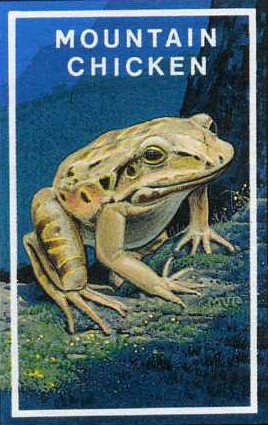
    The Mountain Chicken isn’t a fowl, as its name suggests, but a frog. Kimisha Thomas, hailing from the Caribbean island nation of Dominica, remembers a time when she could find these amphibians or ‘crapaud’ as locals call them “just in the backyard”. Known also as the Giant Ditch Frog, these creatures form a crucial part of Dominica’s national identity, with locals consuming them on special occasions like Independence Day. Today, hunting mountain chicken is banned, as the frogs are fighting for their survival. In fact, scientists estimate that their numbers have dwindled down to just 8,000 individuals. Locals first started noticing that the frogs were behaving abnormally about a decade ago, showing signs of lethargy as well as abrasions on their skin. “Then they began to die,” explained Thomas, an officer with Dominica’s environment ministry. “People also started to get scared, fearing that eating crapauds would make them ill,” she adds. In fact, this fear was not far from the truth; preliminary research has found that Chytridiomycosis, an infectious disease that affects amphibians, was the culprit for the wave of deaths. Besides the mountain chicken, there has been a sharp decline in the population of the sisserou parrot, which is found only in Dominica, primarily in the country’s mountainous rainforests. Thomas says large-scale destruction of the bird’s habitat is responsible for its gradual disappearance from the island. Dominica is not alone in grappling with such a rapid loss of species. According to the Red List of Threatened Species, one of the most comprehensive inventories on the conservation status of various creatures, some 2,599 of 71,576 species recently studied are thought to be endangered.

    The Mountain Chicken isn’t a fowl, as its name suggests, but a frog. Kimisha Thomas, hailing from the Caribbean island nation of Dominica, remembers a time when she could find these amphibians or ‘crapaud’ as locals call them “just in the backyard”. Known also as the Giant Ditch Frog, these creatures form a crucial part of Dominica’s national identity, with locals consuming them on special occasions like Independence Day. Today, hunting mountain chicken is banned, as the frogs are fighting for their survival. In fact, scientists estimate that their numbers have dwindled down to just 8,000 individuals. Locals first started noticing that the frogs were behaving abnormally about a decade ago, showing signs of lethargy as well as abrasions on their skin. “Then they began to die,” explained Thomas, an officer with Dominica’s environment ministry. “People also started to get scared, fearing that eating crapauds would make them ill,” she adds. In fact, this fear was not far from the truth; preliminary research has found that Chytridiomycosis, an infectious disease that affects amphibians, was the culprit for the wave of deaths. Besides the mountain chicken, there has been a sharp decline in the population of the sisserou parrot, which is found only in Dominica, primarily in the country’s mountainous rainforests. Thomas says large-scale destruction of the bird’s habitat is responsible for its gradual disappearance from the island. Dominica is not alone in grappling with such a rapid loss of species. According to the Red List of Threatened Species, one of the most comprehensive inventories on the conservation status of various creatures, some 2,599 of 71,576 species recently studied are thought to be endangered.

    Compiled by the International Union for the Conservation of Nature (IUCN), the Red List aims to increase the number of species assessed to 160,000 by 2020. But even with only half the world’s biological species included in the index, the forecast is bleak.

    While the extinction or threat of extinction of thousands of species poses huge challenges across the board, tribal and indigenous communities are generally first to feel the impacts, and will likely bear the economic and cultural brunt of such losses.

    As Thomas points out, “The crapaud was our national dish. The sisserou parrot [also known as the Imperial Amazon] sits right in the middle of our national flag. Their loss means the loss of our very cultural identity.”

    A similar refrain can be heard among the Parsi community of India, whose culture dictates that the dead be placed in high structures, called ‘towers of silence’, that they may be consumed by birds of prey: kites, vultures and crows. The unique funeral rites are an integral part of the Zoroastrian faith, which stipulates that bodies be returned to nature.

    But over the past two decades, 99 percent of India’s vultures have disappeared, making it impossibly difficult for the Parsi community to keep up with a centuries-old tradition.

    Rising economic burden

    Besides severely affecting ancient cultural and spiritual practices, the disappearance of various species is also taking an economic toll on indigenous communities according to 65-year-old Anil Kumar Singh, who was born and raised in the village of Chirakuti in India’s northeastern hill districts.

    Singh says that as a child, he never saw a doctor for minor ailments like the common cold or an upset stomach.
    We used Vishalyakarni [a herb] for pains and cuts. We drank the juice of basak leaves (adhatoda vasica) for a cough and used the extract from lotus flowers for dysentery,” he tells IPS.
    “But today, these plants don’t grow here anymore. Even when we try, they die out soon and we don’t know the reason. We now have to buy medicines from a chemist’s shop for everything,” he asserts.

    Sometimes, the cost is much higher. Northern Indian states like Haryana and Uttar Pradesh have experienced an explosion in the population of stray dogs, giving rise to health risks among locals.

    By way of explanation, Neha Sinha, advocacy and policy officer of the Bombay Natural History Society in India (BNHS), a Mumbai-based conservation charity, tells IPS that the phenomenon of increasingly feral dogs can be traced to Indian farmers’ practice of leaving dead cattle out in the open to be consumed by birds of prey.

    With no vultures to pick the beasts clean, dogs are now getting to the carcasses, growing more and more vicious and resorting to attacks on humans. BNHS is currently breeding vultures in captivity in order to prevent their complete extinction, but it is unlikely the birds will regain their numbers from 20 years ago.

    Meanwhile, according to a study by Birdlife International, the population of feral dogs in India has grown by 5.5 million due to the disappearance of vultures.

    The report says there have been “roughly 38.5 million additional dog bites and more than 47,300 extra deaths from rabies, [which] may have cost the Indian economy an additional 34 billion dollars.”

    Legal and knowledge gaps

    The near extinction of vultures in India is attributed to diclofenac, a painkiller that is often given to cows and buffalos to which vultures are allergic. Intense campaigning against use of the drug led to a government ban in 2004, but implementation of the law has been poor, and diclofenac is still widely used, according to Singh of BNHS.

    “The farmers know [the drug] is banned but they continue to use it because the law is not being enforced,” she said.

    In several other cases, communities are left confused as to the reasons behind species loss, making it increasingly hard to settle on a solution. For instance, even after a decade of seeing their unique creatures vanish, Dominica still does not know what brought the Chytridiomycosis fungus to their soil, or how to deal with it.

    This knowledge gap is a double whammy for indigenous communities, whose lives and livelihoods depend heavily on the species they have lived side by side with for millennia.

    Lucy Mulenekei, executive director of the Indigenous Information Network (IIN), tells IPS on the sidelines of the 12th meeting of the Conference of the Parties to the Convention on Biological Diversity (COP 12), currently underway in Pyeongchang, South Korea, that the decline in the livestock population in Kenya has affected the Maasai people, a pastoral tribe that has always relied on their herds for sustenance.

    Now forced to live off the land, the tribe is faltering.

    “The Maasai people don’t know what kind of farming tools they need, or how to use them. They don’t know what seeds to use and how to access them. There is a huge gap in knowledge and technology,” explains Mulenekei, who is Maasai herself.

    In response to the growing crisis, governments and U.N. agencies are pushing out initiatives to tackle the problem at its root.

    Carlos Potiara Castro, a technical advisor with the Brazilian environment ministry, is leading one such project in the Bailique Archipelago, 160 km from the Macapa municipality in northern Brazil, where local fisher communities are taught to conserve biodiversity. Already, community members have learned the properties of 154 medicinal plants.

    The annual cost of the project is about 50,000 dollars, but Potiara says a lot more funding will be needed in order to scale up the work and replicate such efforts around the country.

    This might soon be possible under a new initiative launched by the government of Germany together with the United Nations Development Programme (UNDP) and the Global Environment Facility (GEF), which offers 12.3 million euros over a period of five years to indigenous communities in over 130 countries to help them conserve protected areas.

    Yoko Watanabe, a senior biodiversity specialist at the natural resources team of the GEF Secretariat, tells IPS the grants will also cover the cost of trainings, to pass on necessary skills to indigenous communities who are recognised as “indispensable to biodiversity conservation.”

    Source: IPS, 16 October 2014

    Vanishing Species: Local Communities Count their Losses
  • To save the birds, look to the fish

    To save the birds, look to the fish

    Birds that dive for fish while wintering in the Salish Sea, located between British Columbia and Washington, are more likely to be in decline than nondiving birds with less specialized diets, according to a study led by the School of Veterinary Medicine at the University of California, Davis. Diving birds were 11 times more likely to be in decline than nondiving birds, according to the study, published in the journal Conservation Biology. Also, populations of diving birds that rely on forage fish, such as Pacific herring, are 16 times more likely to decline than those with more varied diets. The study lends credence to what scientists have long suspected: “If you want to recover birds, you need to recover the food that they’re eating,” said co-author Joe Gaydos, a UC Davis wildlife veterinarian and director of the SeaDoc Society, a program of the UC Davis Karen C. Drayer Wildlife Health Center. “This could help puffins (Fratercula arctica), western grebes (Aechmophorus occidentalis), common murres (Uria aalge) and other diving species recover.”

    Birds that dive for fish while wintering in the Salish Sea, located between British Columbia and Washington, are more likely to be in decline than nondiving birds with less specialized diets, according to a study led by the School of Veterinary Medicine at the University of California, Davis. Diving birds were 11 times more likely to be in decline than nondiving birds, according to the study, published in the journal Conservation Biology. Also, populations of diving birds that rely on forage fish, such as Pacific herring, are 16 times more likely to decline than those with more varied diets. The study lends credence to what scientists have long suspected: “If you want to recover birds, you need to recover the food that they’re eating,” said co-author Joe Gaydos, a UC Davis wildlife veterinarian and director of the SeaDoc Society, a program of the UC Davis Karen C. Drayer Wildlife Health Center. “This could help puffins (Fratercula arctica), western grebes (Aechmophorus occidentalis), common murres (Uria aalge) and other diving species recover.”

    Wildlife agencies from the U.S. and Canada have separately monitored wintering marine birds in the Salish Sea. Yet birds living there do not recognize its borders. So UC Davis Wildlife Health Center scientists combined 17 years of wintering bird data from both Washington and British Columbia, as well as Audubon Christmas Bird Counts, to develop a risk assessment for the birds and better understand what is driving declines across the entire region.

    “For example, from looking at years of public health trends we know that humans can have certain behaviors that make them more likely to develop adult diabetes,” said lead author Ignacio Vilchis, a postdoctoral research fellow with the UC Davis Wildlife Health Center at the time of the study and now a research scientist at Scripps Institution of Oceanography. “You can interpret wildlife trends similarly, except that habits that place certain wildlife species at risk of decline are the result of much longer time pressures, like natural selection and evolution. So it becomes clear that environmental changes are the actual threat. We therefore think the smoking gun here is that there must be less forage fish available in the Salish Sea for diving birds.”

    The researchers found 148 bird species that frequent the Salish Sea during winter. Of those, 39 were considered the core wintering marine bird community. The scientists separated the birds into two groups: those experiencing declining populations and those that were not. They then looked for shared risk factors and found that diving and diet were the main ecological traits driving the decline.

    The study concludes that a combination of reasons is probably making diving birds more at risk of declines — they get entangled in fishing gear, are more vulnerable to oil spills, and require more calories than most nondiving birds. But the researchers propose that long-term changes in the availability of forage fish are pushing the declines. Half of all Pacific herring stocks in Puget Sound are low, as are herring stocks throughout the Salish Sea. Pacific herring and other forage fish, like surf smelt and Pacific sand lance that spawn in coastal habitats may also be negatively affected by changes in Puget Sound, where 93 percent of the coastline has been altered by dredging, seawalls and removal of vegetation.

    “Now that we have a much better idea what is going on, we can hopefully address it,” Vilchis said.

    The study was funded by the SeaDoc Society, Canadian Wildlife Service and Washington state.
    Source: UC Davis, 16 October 2014
    http://news.ucdavis.edu/search/news_detail.lasso?id=11058

  • Autism is linked to pesticide exposure during pregnancy

    Autism is linked to pesticide exposure during pregnancy

    The closer women live to areas of heavy agricultural pesticide use during pregnancy, the more likely that their children will have autism spectrum disorders, according to a study in Environmental Health Perspectives. The University of California researchers stated that this is the third study to find strong links between autism and proximity exposures to agricultural pesticides, particularly organophosphates, during pregnancy. The research was part of the population-based, case control Childhood Autism Risks from Genetics and Environment (CHARGE) study and involved 970 children. Commercial pesticide application data was mapped in relation to the mothers’ residential addresses during pregnancy, and the children were tested for Autism Spectrum Disorders (ASD) and developmental disabilities. “Approximately one-third of CHARGE study mothers lived, during pregnancy, within 1.5 km (just under 1 mile) of an agricultural pesticide application,” wrote the researchers. “Proximity to organophosphates at some point during gestation was associated with a 60% increased risk for ASD.” The figures were even higher for third-trimester exposures and second-trimester chlorpyrifos applications.

    The closer women live to areas of heavy agricultural pesticide use during pregnancy, the more likely that their children will have autism spectrum disorders, according to a study in Environmental Health Perspectives. The University of California researchers stated that this is the third study to find strong links between autism and proximity exposures to agricultural pesticides, particularly organophosphates, during pregnancy. The research was part of the population-based, case control Childhood Autism Risks from Genetics and Environment (CHARGE) study and involved 970 children. Commercial pesticide application data was mapped in relation to the mothers’ residential addresses during pregnancy, and the children were tested for Autism Spectrum Disorders (ASD) and developmental disabilities. “Approximately one-third of CHARGE study mothers lived, during pregnancy, within 1.5 km (just under 1 mile) of an agricultural pesticide application,” wrote the researchers. “Proximity to organophosphates at some point during gestation was associated with a 60% increased risk for ASD.” The figures were even higher for third-trimester exposures and second-trimester chlorpyrifos applications.

    “Applications of two of the most common agricultural pesticides (organophosphates and pyrethroids) nearby the home may increase the prevalence of ASD,” the researchers wrote. “These findings support the results of two previous studies linking ASD to gestational agricultural pesticide exposure.”

    The study “strengthens the evidence linking neurodevelopmental disorders with gestational pesticide exposures, particularly organophosphates, and provides novel results of ASD and [developmental disability] associations with, respectively, pyrethroids and carbamates,” concluded the researchers.

    An accompanying editorial discusses some of the limitations of the study, but adds that it was compelling and “provides new directions for exploration.” The director of the Division of Environmental Health at Mount Sinai School of Medicine, who was not involved in the research, is then quoted commenting on the study: “Until about five years ago, virtually all research on autism assumed that the disease was entirely genetic in origin, and that environmental exposures did not play a role. Rising rates of autism and failure to find genetic causes despite a multitude of very large genetic studies has led to a major shift in focus in the field… These chemicals are a solid lead that needs to be followed.”

    References:
    Neurodevelopmental Disorders and Prenatal Residential Proximity to Agricultural Pesticides: The CHARGE Study (Shelton, Janie F. et al. Environmental Health Perspectives. October 2014. DOI:10.1289/ehp.1307044)

    Pesticides and Autism Spectrum Disorders: New Findings from the CHARGE Study (Holzman, David C. Environmental Health Perspectives. October 2014. DOI:10.1289/ehp.122-A280)

    Source: Mad in America, October 14th, 2014
    http://www.madinamerica.com/2014/10/third-study-links-pesticide-exposure-pregnancy-autism/

    This entry was posted in Autism, Causation Theories, Environmental, Featured News, In the News by Rob Wipond.

  • Imidacloprid poisoning: a modern foe

    Imidacloprid poisoning: a modern foe

    Imidacloprid is a relatively new insecticide in the chloronicotinyl nitroguanidine class. Imidacloprid has a wide variety of uses; it is used on cotton and vegetable crops, turf grass and ornamental plant products, in indoor and outdoor cockroach control products and in termite control products. Imidacloprid acts as a competitive inhibitor at nicotinic acetylcholine receptors in the nervous system resulting in impairment of normal nerve function. Scientific literature on human imidacloprid poisoning has been relatively sparse. We report three subjects who presented with imidacloprid poisoning.

    Imidacloprid is a relatively new insecticide in the chloronicotinyl nitroguanidine class. Imidacloprid has a wide variety of uses; it is used on cotton and vegetable crops, turf grass and ornamental plant products, in indoor and outdoor cockroach control products and in termite control products. Imidacloprid acts as a competitive inhibitor at nicotinic acetylcholine receptors in the nervous system resulting in impairment of normal nerve function. Scientific literature on human imidacloprid poisoning has been relatively sparse. We report three subjects who presented with imidacloprid poisoning.

    Source:
    Sibia RS, S Amith Kumar, Dhoot SR. Imidacloprid poisoning: a modern foe. Int J Res Med Sci 2014;2:752-4.

  • Metabolic degradation of imidacloprid in paddy field soil

    Metabolic degradation of imidacloprid in paddy field soil

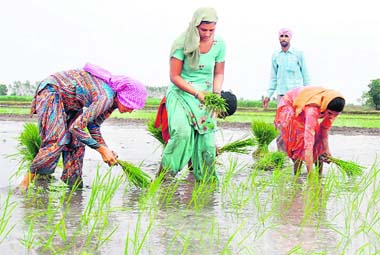
    The metabolic degradation and persistence of imidacloprid in paddy field soil were investigated following two applications of imidacloprid at 20 and 80 g a.i. ha−1 at an interval of 10 days. The soil samples were collected at various time intervals. The limit of quantification for the analysis of imidacloprid and its metabolites was obtained at the concentration of 0.01 mg kg−1. The initial deposits of total imidacloprid were found to be 0.44 and 1.61 mg kg−1 following second applications. These residues could not be detected after 60 and 90 days following second applications of imidacloprid at lower and higher dosages, respectively. In soil, urea metabolite was found to be the maximum, followed by olefine, nitrosimine, 6-chloronicotinic acid, 5-hydroxy and nitroguanidine. The half-life values (t 1/2) of imidacloprid were worked out to be 12.04 and 11.14 days, respectively, when applied at lower and higher doses, respectively.

    The metabolic degradation and persistence of imidacloprid in paddy field soil were investigated following two applications of imidacloprid at 20 and 80 g a.i. ha−1 at an interval of 10 days. The soil samples were collected at various time intervals. The limit of quantification for the analysis of imidacloprid and its metabolites was obtained at the concentration of 0.01 mg kg−1. The initial deposits of total imidacloprid were found to be 0.44 and 1.61 mg kg−1 following second applications. These residues could not be detected after 60 and 90 days following second applications of imidacloprid at lower and higher dosages, respectively. In soil, urea metabolite was found to be the maximum, followed by olefine, nitrosimine, 6-chloronicotinic acid, 5-hydroxy and nitroguanidine. The half-life values (t 1/2) of imidacloprid were worked out to be 12.04 and 11.14 days, respectively, when applied at lower and higher doses, respectively.

    Source: Romila Akoijam, Balwinder Singh. Metabolic degradation of imidacloprid in paddy field soil. Environmental Monitoring and Assessment October 2014, Volume 186, Issue 10, pp 5977-5984
    http://link.springer.com/article/10.1007/s10661-014-3833-3

  • GM genes ‘jump species barrier’

    GM genes ‘jump species barrier’

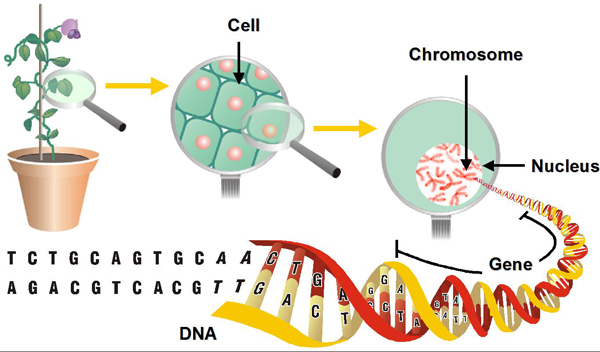
    A leading zoologist has found evidence that genes used to modify crops can jump the species barrier and cause bacteria to mutate, prompting fears that GM technology could pose serious health risks. A four-year study by Professor Hans-Hinrich Kaatz, a respected German zoologist, found that the alien gene used to modify oilseed rape had transferred to bacteria living inside the guts of honey bees. The research – which has yet to be published and has not been reviewed by fellow scientists – is highly significant because it suggests that all types of bacteria could become contaminated by genes used in genetically modified technology, including those that live inside the human digestive system. If this happened, it could have an impact on the bacteria’s vital role in helping the human body fight disease, aid digestion and facilitate blood clotting.

    A leading zoologist has found evidence that genes used to modify crops can jump the species barrier and cause bacteria to mutate, prompting fears that GM technology could pose serious health risks. A four-year study by Professor Hans-Hinrich Kaatz, a respected German zoologist, found that the alien gene used to modify oilseed rape had transferred to bacteria living inside the guts of honey bees. The research – which has yet to be published and has not been reviewed by fellow scientists – is highly significant because it suggests that all types of bacteria could become contaminated by genes used in genetically modified technology, including those that live inside the human digestive system. If this happened, it could have an impact on the bacteria’s vital role in helping the human body fight disease, aid digestion and facilitate blood clotting.

    Agriculture Minister Nick Brown, who was yesterday advising farmers who have accidentally grown contaminated GM oilseed rape in Britain to rip up their crops, confirmed the potential significance of Kaatz’s research. He said: ‘If this is true, then it would be very serious.’

    The 47-year-old Kaatz has been reluctant to talk about his research until it has been published in a scientific journal, because he fears a backlash from the scientific community similar to that faced by Dr Arpad Pustzai, who claimed that genetically modified potatoes damaged the stomach lining of rats. Pustzai was sacked and had his work discredited.

    But in his first newspaper interview, Kaatz told The Observer: ‘It is true, I have found the herbicide-resistant genes in the rapeseed transferred across to the bacteria and yeast inside the intestines of young bees. This happened rarely, but it did happen.’

    Advertisement

    Although Kaatz realised the potential ‘significance’ of his findings, he said he ‘was not surprised’ at the results. Asked if this had implications for the bacteria inside the human gut, he said: ‘Maybe, but I am not an expert on this.’

    Dr Mae-Wan Ho, geneticist at Open University and a critic of GM technology, has no doubts about the dangers. She said: ‘These findings are very worrying and provide the first real evidence of what many have feared. Everybody is keen to exploit GM technology, but nobody is looking at the risk of horizontal gene transfer.

    ‘We are playing about with genetic structures that existed for millions of years and the experiment is running out of control.’

    One of the biggest concerns is if the anti-biotic resistant gene used in some GM crops crossed over to bacteria. ‘If this happened it would leave us unable to treat major illnesses like meningitis and E coli .’

    Kaatz, who works at the respected Institute for Bee Research at the University of Jena in Germany, built nets in a field planted with genetically modified rapeseed produced by AgrEvo. He let the bees fly freely within the net. At the beehives, he installed pollen traps in order to sample the pollen from the bees’ hindlegs when entering the hive.

    This pollen was fed to young honey bees in the laboratory. Pollen is the natural diet of young bees, which need a high protein diet. Kaatz then extracted the intestine of the young bees and discovered that the gene from the GM rape-seed had been transferred in the bee gut to the microbes.

    Professor Robert Pickard, director-general of the Institute of the British Nutrition Foundation, is a bee expert as well as being a biologist and has visited the institute where Kaatz works. He said: ‘There is no doubt that, if Kaatz’s research is substantiated, then it poses very interesting questions and will need to be looked at very closely.

    ‘But it must be remembered that the human body has been coping perfectly well with strange DNA for millions of years. And we also know many people have been eating GM products for years without showing any signs of ill health.’
    Source: The Guardian, 28 May 2000
    http://www.theguardian.com/science/2000/may/28/gm.food?CMP=twt_gu

  • Omslag nodig in landbouw, bosbouw, visserij en waterbeheer om biodiversiteitsverlies te stoppen

    Omslag nodig in landbouw, bosbouw, visserij en waterbeheer om biodiversiteitsverlies te stoppen

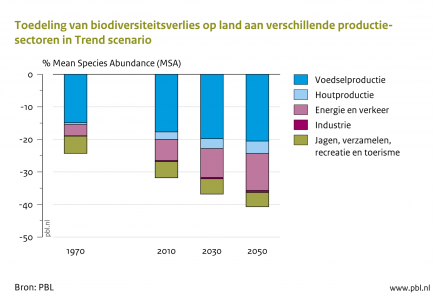
    Hoewel internationale inspanningen om het verlies van biodiversiteit te stoppen op enkele terreinen resultaat boeken, leiden deze tot op heden niet tot verbetering in de toestand van de natuur wereldwijd. Landbouw, bosbouw, visserij en waterbeheer zijn de belangrijkste veroorzakers van het verlies van biodiversiteit, maar kunnen ook een sleutelrol spelen in de oplossing. Volgens prognoses van het PBL neemt de biodiversiteit bij ongewijzigd beleid wereldwijd in de komende 40 jaar met 10% af. Dit is het gevolg van een 50-70% toename in de vraag naar voedsel, hout, energie en water voor een groeiende en steeds rijker wordende wereldbevolking. Dit is geïllustreerd in onderstaande figuur waarin de verliezen in biodiversiteit (uitgedrukt in de biodiversiteitsmaat ‘Mean Species Abundance’) worden toegerekend aan verschillende sectoren. Alleen door ingrijpende veranderingen in de productiewijzen in genoemde sectoren en een beleid van lange adem kan de achteruitgang worden vertraagd.

    Hoewel internationale inspanningen om het verlies van biodiversiteit te stoppen op enkele terreinen resultaat boeken, leiden deze tot op heden niet tot verbetering in de toestand van de natuur wereldwijd. Landbouw, bosbouw, visserij en waterbeheer zijn de belangrijkste veroorzakers van het verlies van biodiversiteit, maar kunnen ook een sleutelrol spelen in de oplossing. Volgens prognoses van het PBL neemt de biodiversiteit bij ongewijzigd beleid wereldwijd in de komende 40 jaar met 10% af. Dit is het gevolg van een 50-70% toename in de vraag naar voedsel, hout, energie en water voor een groeiende en steeds rijker wordende wereldbevolking. Dit is geïllustreerd in onderstaande figuur waarin de verliezen in biodiversiteit (uitgedrukt in de biodiversiteitsmaat ‘Mean Species Abundance’) worden toegerekend aan verschillende sectoren. Alleen door ingrijpende veranderingen in de productiewijzen in genoemde sectoren en een beleid van lange adem kan de achteruitgang worden vertraagd.

    Naast landbouw, bosbouw, visserij en de watersector is ook de energie- en vervoerssector verantwoordelijk voor de verwachte achteruitgang van biodiversiteit. Mogelijke biodiversiteitsvriendelijke veranderingen in de landbouw zijn:
    – de teelt en oogst van bijvoorbeeld hout, soja, vis en palmolie verder verduurzamen;
    – ecologisering van de landbouw in hoogproductieve gebieden om de druk op natuur te verminderen;
    – minder vlees eten;
    – voedselverspilling in productie en consumptie verminderen.

    Deze opties worden niet vanzelf gerealiseerd. Naast primaire producenten (boeren, bosbouwers, vissers) kunnen en moeten hierbij ook consumenten en bedrijven door de hele keten heen een bijdrage leveren om het verlies aan biodiversiteit als gevolg van de primaire productie te stoppen. Dat vraagt bijvoorbeeld dat biodiversiteit een duidelijke plek krijgt in duurzaamheidsinitiatieven in de productieketen. Tot op heden is dat nog onvoldoende het geval. Voor consumenten is het belang van biodiversiteit voor gezonde voeding nog onvoldoende duidelijk, en dat geldt ook voor de gevolgen van het eten van vlees en melkproducten voor biodiversiteit. Supermarkten, restaurants, horeca en kookprogramma’s kunnen een belangrijke rol spelen in het laten zien hoe productieomstandigheden en consumptie met elkaar verbonden zijn. Overheden kunnen een belangrijke bijdrage leveren door het belang van natuurlijk kapitaal voor economische sectoren zichtbaar te maken, voorlopers te ondersteunen, leren en uitwisseling van ervaringen te bevorderen en een minimum niveau van wetten en regelgeving te handhaven.

    Bron: PBL, 6-10-14
    http://www.pbl.nl/nieuws/nieuwsberichten/2014/omslag-nodig-in-landbouw-bosbouw-visserij-en-waterbeheer-om-biodiversiteitsverlies-te-stoppen

  • In Nederland heeft bijna een derde van de bevolking een of meer chronische ziekten

    In Nederland heeft bijna een derde van de bevolking een of meer chronische ziekten

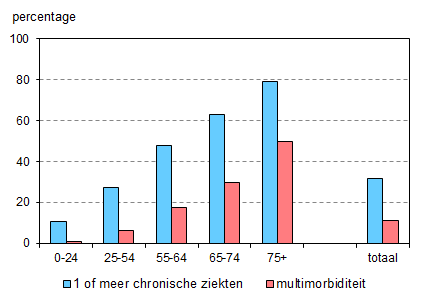
    Dit komt neer op 5,3 miljoen mensen. Deze schatting is gebaseerd op een selectie van 28 chronische ziekten, gemeten in de huisartspraktijk. Chronische ziekten komen op alle leeftijden voor, maar vooral onder ouderen. Van de mensen van 65 jaar en ouder heeft 70% een chronische ziekte. Onder de 65 jaar hebben meer vrouwen dan mannen een chronische ziekte, daarboven is er relatief gezien nauwelijks verschil tussen mannen en vrouwen. In totaal zijn er meer vrouwen dan mannen met een chronische ziekte, onder andere omdat er meer oudere vrouwen zijn dan oudere mannen. Vijfendertig procent van de mensen met een chronische ziekte heeft meer dan één chronische ziekte (op basis van dezelfde selectie van 28 ziekten). Dit komt neer op 1,9 miljoen mensen ofwel 11% van de totale Nederlandse bevolking.

    Dit komt neer op 5,3 miljoen mensen. Deze schatting is gebaseerd op een selectie van 28 chronische ziekten, gemeten in de huisartspraktijk. Chronische ziekten komen op alle leeftijden voor, maar vooral onder ouderen. Van de mensen van 65 jaar en ouder heeft 70% een chronische ziekte. Onder de 65 jaar hebben meer vrouwen dan mannen een chronische ziekte, daarboven is er relatief gezien nauwelijks verschil tussen mannen en vrouwen. In totaal zijn er meer vrouwen dan mannen met een chronische ziekte, onder andere omdat er meer oudere vrouwen zijn dan oudere mannen. Vijfendertig procent van de mensen met een chronische ziekte heeft meer dan één chronische ziekte (op basis van dezelfde selectie van 28 ziekten). Dit komt neer op 1,9 miljoen mensen ofwel 11% van de totale Nederlandse bevolking.

    Bron: RIVM, 23 juni 2014
    http://www.nationaalkompas.nl/gezondheid-en-ziekte/ziekten-en-aandoeningen/chronische-ziekten-en-multimorbiditeit/hoeveel-mensen-hebben-een-of-meer-chronische-ziekten/