Amfibie: Algemeen

  • Kiebitze und Unken verschwinden im Rhein-Main-Gebiet

    Kiebitze und Unken verschwinden im Rhein-Main-Gebiet

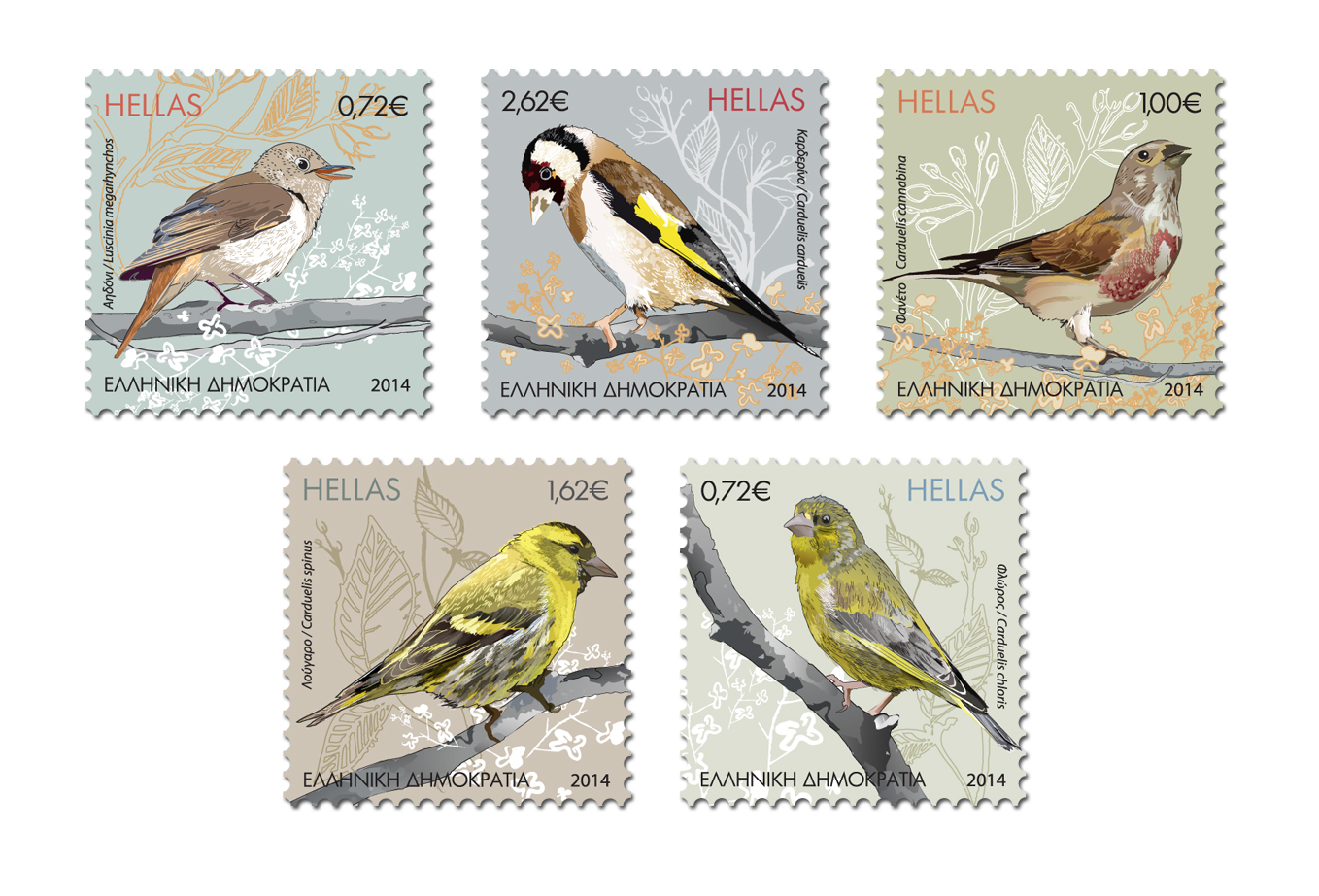
    Als besonders bedrohlich erweist sich die immer intensivere Landwirtschaft. „Auf den Äckern und Wiesen stellen wir einen massiven Artenrückgang fest“, sagt NABU-Mitarbeiter Mark Harthun. Acker-Bodenbrüter wie Feldlerche (Alauda arvensis) und Kiebitz (Vanellus vanellus) gebe es in Hessen immer seltener. Auf den Äckern nisten die Tiere nicht, weil Jahr für Jahr in riesigen Mengen Pestizide gesprüht werden. Nicht nur wegen der Giftstoffe selbst, sondern auch weil die Getreide- und Grashalme durch das Düngen immer dichter wachsen, brüten dort kein Vögel mehr, wie es heißt. Sie könnten nicht mehr beobachten, ob sich Feinde, etwa Füchse, näherten, und scheuten deshalb Wiesen und Felder. Typisches Opfer der modernen Landwirtschaft ist das Braunkehlchen (Saxicola rubetra), das jahrhundertelang auf Zaunpfählen saß, um einen guten Überblick zu haben. Jetzt gebe es kaum noch Pfähle auf den Feldern, sagt Harthun. Verschwunden sind auch Auen und Auwälder, die es früher an allen Flüssen gab und die ursprünglich zu den artenreichsten Lebensräumen zählten. Dort fühlte sich einst die Nachtigall (Luscinia megarhynchos) wohl, die man mittlerweile fast nur noch aus Frühlingsliedern kennt. Auch Amphibien wie Gelbbauchunke (Bombina variegata) und Kreuzkröte (Epidalea calamita, Synonym: Bufo calamita), laut EU streng geschützte Arten, können ohne feuchte Wiesen und Tümpel, die durch regelmäßiges Hochwasser entstehen, nicht überleben.

    Selbst ganz normale Wiesen sind kaum noch zu finden. Entweder werden die Flächen zu Ackerland gemacht, oder aber sie werden so stark gedüngt, dass sich nur noch Gras, Löwenzahn und Butterblume durchsetzen. „Es fehlen die blütenreichen Wiesen“, sagen Experten. Das bedeute nicht nur Monotonie in der Pflanzenwelt. Auch die Vielfalt der Insekten, etwa unter den Schmetterlingen, nehme ab.

    In diesem Frühjahr haben die Ergebnisse einer Erhebung von Nabu und Krefelder Insektenkundlern für Aufregung gesorgt. Sie stellen seit Jahren Insektenfallen auf und vergleichen die Mengen. Dabei registrierten sie nun, dass innerhalb von 20 Jahren die Zahl der Insekten um bis zu 80 Prozent gesunken ist. „Wissen Sie noch, wie viele tote Insekten früher nach einer langen Autofahrt an der Windschutzscheibe klebten?“, fragt Harthun. Mittlerweile bleibe sie fast sauber.

    Quelle: Frankfurter Allgemeine, 25.05.2016
    http://www.faz.net/aktuell/rhein-main/rueckgang-der-artenvielfalt-in-rhein-main-14247571.html

  • Amphibians in continued global decline

    Amphibians in continued global decline

    A new study led by scientists with the U.S. Geological Survey confirms the ongoing decline of amphibians around the world. While every part of the United States continues to experience a decline in amphibian populations, the major threats vary from region to region. The negative effects of pesticide use are especially pronounced east of the Colorado River, while human development and disease are driving the decline east of the Mississippi River. The latest analysis suggests amphibian populations are declining at a rate of 3.79 percent per year. That’s roughly in line with previous USGS findings. Should such a decline continue, many amphibian species will become extinct across large portions of the U.S. “Losing 3 or 4 percent of amphibian populations might not sound like a big deal but small losses year in and year out quickly lead to dramatic and consequential declines,” added study co-author Michael Adams, lead scientist with the USGS Amphibian Research and Monitoring Initiative.

    Source: UPI, May 23, 2016
    http://www.upi.com/Science_News/2016/05/23/Amphibians-in-continued-global-decline/8341464025350/

  • Rachel Carson’s Silent Spring sounded the alarm. The problem hasn’t gone away, it’s only intensified

    Rachel Carson’s Silent Spring sounded the alarm. The problem hasn’t gone away, it’s only intensified

    Despite a steady rise in the manufacture and release of synthetic chemicals, research on the ecological effects of pharmaceuticals, pesticides, and industrial chemicals is severely lacking. This blind spot undermines efforts to address global change and achieve sustainability goals. So reports a new study in Frontiers in Ecology and the Environment. Emma J. Rosi , a freshwater ecologist at the Cary Institute and a co-author on the paper, explains, “To date, global change assessments have ignored synthetic chemical pollution. Yet these chemicals are increasing at a rate that is on par, or more rapid, than other agents of global change, such as CO2 emissions or nutrient pollution.”

    The study’s team assessed global trends in synthetic chemical pollution since the 1970s and compared results to other drivers of global change. Then they surveyed leading ecological journals, U.S. ecological meeting presentations, and National Science Foundation grants for research on synthetic chemicals. Less than 1% of the journal articles, 1.3% of the presentations, and 0.01% of the NSF grants explored the environmental effects or fate of these chemicals.

    Author Emily S. Bernhardt , professor of biogeochemistry at Duke’s Nicholas School of the Environment, comments, “Research on the ecological impacts of synthetic chemical pollution has been static since the 1970s. But our portfolio of these manufactured chemicals keeps growing – with more than 80,000 now in use commercially. This knowledge gap is becoming a chasm, with real consequences for ecological health.”

    Synthetic chemicals meet the criteria set out by the Millennium Ecosystem Assessment to define agents of global change: they are globally distributed, they increase in relation to human populations and economic growth, and they have known impacts on organisms. Yet they have largely remained below the radar of global assessments.

    Pesticides, pharmaceuticals, and industrial chemicals can leave long-term toxic legacies that ripple through ecosystems. Traditional ecotoxicology, done in laboratory settings on individual chemicals, bears little resemblance to the behavior of these compounds in nature. Some accumulate in food webs; others become more toxic due to reactions with chemicals already in the environment or through transformations by organisms or sunlight.

    Co-author Mark O. Gessner of Germany’s Leibniz Institute of Freshwater Ecology and Inland Fisheries (IGB) explains, “Identifying the environmental threat of synthetic chemicals as a whole relies on new concepts and greatly intensified research. At present there is grossly insufficient information to assess the environmental impact of the wide variety of synthetic chemicals in use today, particularly when it comes to effects at a large scale and in the long run.”

    The study’s results reveal that the National Science Foundation, the primary funding agency for U.S. ecological research, is not supporting ecological research on synthetic chemicals. Compounding the problem – other U.S. government agencies and private foundations that once funded long term field research on these contaminants have had their budgets cut, or have redirected their funding streams to human health and lab-based studies that fall short of capturing natural complexity.

    Among the paper’s recommendations: accelerating synthetic chemical impact research by mobilizing increased funding, fostering collaboration among ecologists and ecotoxicologists to better predict and reduce environmental harm by synthetic chemicals, and launching an internationally-coordinated effort to assess how synthetic chemical pollution impacts the goals and targets of the Intergovernmental Panel on Climate Change (IPCC), the Intergovernmental Panel on Biodiversity and Ecosystem Services (IPBES), and the Sustainable Development Goals (SDGs).

    Rosi concludes, “In the 1960s, Rachel Carson’s Silent Spring sounded the alarm on the environmental dangers of synthetic chemicals. The problem hasn’t gone away, it’s only intensified, and we need to reawaken awareness. Synthetic chemicals are leading agents of global change and it’s essential that we invest in the research needed to understand and minimize their impacts.”

    Source: ChemEurope, 25 January 2017
    http://www.chemeurope.com/en/news/161537/synthetic-chemicals-ignored-agents-of-global-change.html

  • Farmers must use an alternative to pesticides to save amphibians from complete extinction

    Farmers must use an alternative to pesticides to save amphibians from complete extinction

    A study published in SAPIENS revealed that out of 15,589 species threatened with extinction, 12% of them are bird species, 23% are mammal species are threatened, and 32% are amphibians. The first amphibian decline was documented in the 1960s. At present, the research revealed the average amphibian population decline has reached 3.79 % per year. As amphibian crisis persists across the United States, scientists are working continuously to come up with an emergency response to reverse their decline. Writing in the journal Scientific Reports, researchers from the U.S. Geological Survey said there is no “smoking gun” to shut down the direct cause of their crumbling population all at once, as the new study revealed that reasons for amphibians’ population decline varies across regions.They found out four main threats to amphibians’ populate decline and the threats to amphibians differ from region to region – human influence from the Mississippi River east, including the metropolitan areas of the Northeast and the agriculture-dominated landscapes of the Midwest; disease particularly chytrid fungus in the Upper Midwest and New England, pesticide application at east of the Colorado River, and climate change across the southern United States and the West Coast. Chytrid fungus (Batrachochytrium dendrobatidis) is the worst disease recorded in amphibian history. Savethefrogs.com has identified 287 species of amphibians across 36 countries that are affected by the disease. Although there were many reasons identified, the obvious is that amphibians are largely impacted by human activities. The environmental impacts of toxic wastes contributed by humans to pursue for a thriving industry make the amphibians’ surroundings inhabitable. Being reliant in their aquatic environment, the quality of the water in which they live can affect their growth, development and survival. It is thought that having the ability to live both in aquatic and terrestrial territory makes them twice as vulnerable to threats. Having exposed skin and eggs laid without protection, they are defenseless and may readily absorb toxic substances from the environment. To save the species from complete extinction, farmers must use an alternative to pesticides. This can directly help in the diminishing amphibian population. In addition, people must maintain the natural ground cover and aquatic vegetation to serve as shelter to the species. On a more specific note, monitoring and conducting more research about the threatened amphibian species is strongly advised.
    Source: Nature World News, May 25, 2016
    http://www.natureworldnews.com/articles/22906/20160525/are-amphibians-about-to-go-extinct-the-amphibian-crisis-is-worse-than-you-think.htm

  • NABU bangt um Weiterführung der Bildungswerkstatt Natur

    NABU bangt um Weiterführung der Bildungswerkstatt Natur

    Eine erschreckende Bilanz hat unlängst NRW-Landesumweltminister Johannes Remmel vorgelegt: Rund 44 Prozent unserer heimischen Tier- und Pflanzenarten sind mittlerweile in ihrem Bestand gefährdet und haben somit einen unrühmlichen Platz auf der Roten Liste ergattert. Und am Niederrhein? Leider ist auch hier das Ergebnis katastrophal. Selbst in den meisten Schutzgebieten geht der Artenschwund signifikant weiter. Insbesondere auf landwirtschaftlich genutzten Flächen ist die Artenvielfalt in den letzten Jahren rapide zurückgegangen. Gülleschwemme und Pestizide machen Wissenschaftler dafür verantwortlich. Aber auch in fast allen anderen Lebensräumen bei uns sind die Arten auf dem Rückzug. Unfreiwillig.

    Dabei wird das heimliche Verschwinden vieler Spezies häufig von der Bevölkerung gar nicht mehr wahrgenommen. Wie denn auch? Allgemein sind heute Artenkenntnisse bei den Menschen nur noch rudimentär vorhanden. Das Naturkunde-Basiswissen, was früher noch in den Familien, Kindergärten und Schulen vermittelt wurde, ist heute dort kaum noch vorhanden. Somit fehlen auch zunehmend sachkundige Mitstreiter für die Belange der Natur. Dagegen anzusteuern hat sich die Kreisgruppe Wesel im Naturschutzbund Deutschland (NABU) schon vor Jahren auf die Fahnen geschrieben. Allein in den letzten zwei Jahren konnten sieben neue NABU-Kindergruppen im Kreis Wesel ins Leben gerufen werden, die allesamt von erfahrenden, ausgebildeten Naturerlebnispädagoginnen geleitet werden. „Es ist beeindruckend mit welcher Begeisterung sich Kinder für alles interessieren was kreucht und fleucht, wenn sie spielerisch-pädagogisch dazu angeleitet werden“, freut sich NABU-Kreisvorsitzender Peter Malzbender.
    Kleine Kinder an die Natur heranführen soll zudem zusätzlich mit dem Projekt NABU-Bildungswerkstatt unterstützt werden. Das Projekt läuft nunmehr seit acht Jahren. Und zunehmend erfolgreich. Zurzeit pflegt der NABU mit über 90 Einrichtungen im Kreis Wesel Kooperationen. Kindergärten, Familienzentren und Grundschulen sind vorgesehen, die davon auch reichlich Gebrauch machen. So konnten in den letzten vier Jahren bei 256 Veranstaltungen insgesamt über 3000 Kinder Naturkunde hautnah erfahren. Die NABU-Bildungswerkstatt wird vom Kreis mit knapp 10.000 € pro Jahr gefördert. Dieses Geld wird benötigt für Sachkosten die anfallen. Baumaterialien für Nistkästen und Insektenhotels sowie Becherlupen, Bestimmungsmaterial und Kinder-Forscherausrüstung. Aber auch das Honorar für Fachkräfte sowie die Bustransfers für die Kinder zu einigen auserwählten Naturerlebnisräumen schlagen zu Buche. Die Ausgaben werden übrigens auf Heller und Cent von der Kreisbehörde Wesel geprüft. Ehrenamtlich leistet der NABU für dieses Projekt 400 Stunden pro Jahr.

    Der Naturschutzverband möchte die Bildungswerkstatt auch für die nächsten vier Jahre unbedingt weiterführen. Die weitere Förderung muss aber im Kreistag entschieden werden. Der Umwelt- und Planungsausschuss im Kreis Wesel hat dazu mehrheitlich bei seiner Sitzung am 30.11.2016 grünes Licht gegeben. NABU-Chef Malzbender appelliert: „Auch unsere Kooperationspartner hoffen doch sehr, dass diese nachhaltigen Naturerlebnisprogramme für die Kleinsten weitergeführt werden können.“

    Das hat der NABU für die Bildungswerkstatt Natur 2017-2020 vorgesehen:
    • Zukünftig sollen alle Veranstaltungen nach dem Konzept „Bildung für nachhaltige Entwicklung (BNE)“ ausgerichtet werden
    • 64 Veranstaltungen pro Jahr stehen weiter auf dem Programm
    • Nach wie vor ist das Angebot für die Kooperationspartner kostenlos
    • Themenschwerpunkte wurden aus den Erfahrungen der letzten 8 Jahre entwickelt
    • Dabei wurden Naturerlebnisse herausgesucht, die sich insbesondere bzgl. der Natur- und Umweltpädagogik für Kinder bewährt haben
    • Die Kinder sollen in verschiedenen heimischen Lebensräumen, die hier lebenden Tiere und Pflanzen hautnah kennenlernen
    Quelle: Lokal Kompass, 21.12.16
    http://www.lokalkompass.de/wesel/natur/nabu-bangt-um-weiterfuehrung-der-bildungswerkstatt-natur-d723109.html

  • Reciprocal effects of pesticides and pathogens on amphibian hosts

    Reciprocal effects of pesticides and pathogens on amphibian hosts

    Ecological communities are increasingly exposed to natural and anthropogenic stressors. While the effects of individual stressors have been broadly investigated, there is growing evidence that multiple stressors are frequently encountered underscoring the need to examine interactive effects. Pesticides and infectious diseases are two common stressors that regularly occur together in nature. Given the documented lethal and sublethal effects of each stressor on individuals, there is the potential for interactive effects that alter disease outcomes and pesticide toxicity. Using larval wood frogs (Lithobates sylvaticus), we examined the reciprocal interaction between insecticides (carbaryl and thiamethoxam) and the viral pathogen ranavirus by testing whether: (1) prior ranavirus infection influences pesticide toxicity and (2) sublethal pesticide exposure increases susceptibility to and transmission of ranavirus. We found that prior infection with ranavirus increased pesticide toxicity; median lethal concentration (LC50) estimates were reduced by 72 and 55% for carbaryl and thiamethoxam, respectively. Importantly, LC50 estimates were reduced to concentrations found in natural systems. This is the first demonstration that an infection can alter pesticide toxicity. We also found that prior pesticide exposure exacerbated disease-induced mortality by increasing mortality rates, but effects on infection prevalence and transmission of the pathogen were minimal. Collectively, our results underscore the importance of incorporating complexity (i.e. order and timing of exposures) into research examining the interactions between natural and anthropogenic stressors. Given the environmental heterogeneity present in nature, such research will provide a more comprehensive understanding of how stressors affect wildlife.
    Source: Katherine M. Pochini, Jason T. Hoverman. Environmental Pollution xxx (2016) 1e8

  • De knoflookpad wordt sterk bedreigd door milieuverontreiniging met imidacloprid

    De knoflookpad wordt sterk bedreigd door milieuverontreiniging met imidacloprid

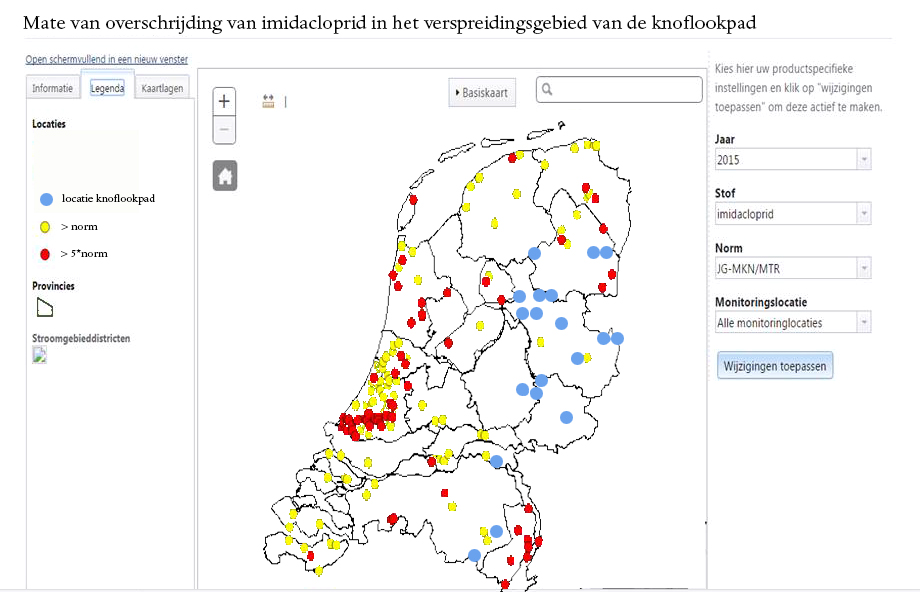
    De knoflookpad (Pelobates fuscus) is een plompe pad met opvallend uitpuilende ogen met verticale pupillen. Zijn leefgebied bestaat uit rivierduinen en kleinschalig agrarisch landschap met bos in de nabijheid. De knoflookpad is gebonden aan de stroomdalen van beken en rivieren in het oosten en zuidoosten van Nederland. De knoflookpad is op dit moment één van de meest bedreigde amfibieën in Nederland. Sinds 1990 zijn er in Nederland nog maar 38 leefgebieden van de knoflookpad bekend, daarvoor was hij bekend van meer dan 100 leefgebieden. Tegenwoordig is het belangrijkste leefgebied van de knoflookpad in Overijssel het stroomgebied van de Overijsselse Vecht. Dit is het grootste bolwerk van de soort in Nederland. Twente was vroeger ook een belangrijke regio. Helaas zijn de meeste leefgebieden hier verdwenen. Een aantal leefgebieden liggen nog langs weerszijden van de IJssel. In Limburg resteren nog slechts drie leefgebieden. De Knoflookpad wordt in al deze gebieden in haar voortbestaan bedreigd. Vooral in Midden-Limburg is de situatie uiterst alarmerend. Van de meer dan 25 wateren waar de soort hier in het verleden is waargenomen resteert er tegenwoordig nog één. Deze populatie in Nationaal Park De Meinweg verkeert op de rand van uitsterven. Hiermee zouden de laatste Knoflookpadden van Midden-Limburg verloren gaan.

    De knoflookpad is een insectivoor (insecteneter). Insecten worden in het verspreidingsgebied van de knoflookpad bedreigd door verontreiniging van het oppervlaktewater met het insecticide imidacloprid. Tijdens de voortplanting in het water pakt het knoflookpadmannetje het vrouwtje in de liezen vast en hangt als het ware achter aan het vrouwtje. De voortplantingswateren bevinden zich vooral bij of op hogere zandgronden in de directe omgeving van geschikte leefomgeving op het land. De knoflookpad gebruikt verschillende type wateren bij voorkeur matig voedselrijk tot voedselrijk om zich voort te planten zoals:vennen, kolken, geïsoleerde rivierarmen, poelen, en (tuin-)vijvers. Belangrijk voor de knoflookpad is dat er in het water hoog opgaande planten (riet, lisdodde) of takken aanwezig zijn waaraan de eisnoeren kunnen worden opgehangen. Omdat de knoflookpad zich vanaf april voortplant is het belangrijk dat het gebruikte water tot eind augustus water houdt, wanneer de jonge padden het land op gaan.

    Gebruikte bron: RAVON
    http://www.ravon.nl/Infotheek/Soortinformatie/Amfibie%C3%ABn/Knoflookpad/tabid/1367/Default.aspx

  • Salamanders of the highlands of Mexico are closer to extinction than any other on Earth

    Salamanders of the highlands of Mexico are closer to extinction than any other on Earth

    Researchers report three new species of the world’s smallest salamander from the remote mountains of Oaxaca, Mexico. They also warn that the rare creatures are already in danger of dying out. The three new species are from the enigmatic genus Thorius, the adults of which are smaller than a matchstick. They are, in fact, the smallest four-legged tailed organism on Earth, and their miniaturized bodies are highly unusual for vertebrates, with structures for feeding being among the most prominent.

    Although once extremely abundant, populations of Thorius have declined precipitously over the last 30 to 35 years, and living Thorius are now rarely found in nature. The findings underscore the large number of amphibian species that remain to be discovered and formally described, and the need to find and save them before they are lost. “Salamanders of the highlands of Mexico are closer to extinction than any other on Earth,” says David Wake, one of the coauthors of a paper about the new species in the journal PeerJ. “The main factors are habitat conversion and new infectious diseases.”

    Wake is a professor of the graduate school in the University of California, Berkeley’s department of integrative biology and a founder of AmphibiaWeb, an online compendium of information about amphibians and their conservation.

    Thorius were first discovered in the 19th century, and for the next 75 years scientists believed there was only a single species. Nine additional species were discovered between 1940 and 1960, but the adults are so small that the species were hard to tell apart.

    A breakthrough came in the 1970s, when biologists discovered that many species, while anatomically similar, could be readily told apart by using molecular techniques, which then revealed subtle anatomical features that differentiate them. Since then, many more species have been discovered and named and the three newly named species bring the current total to 29.

    The current research began in the early 1970s and involved extensive fieldwork in southern Mexico over several decades in order to sample critical populations in remote areas. A combination of sophisticated molecular analyses, including DNA sequencing; digital imaging, such as X-ray computed tomography; and statistical analysis of external and internal anatomy uncovered new species.

    They have been named Thorius pinicola (meaning “pine-dwelling minute salamander”), Thorius longicaudus (“long-tailed minute salamander”), and Thorius tlaxiacus (“heroic minute salamander”).

    “We have known about the salamanders we have described for decades, at a time when they were exceedingly common, but only recently have we obtained evidence that they are indeed new species, though now critically endangered,” Wake says. “This is a common experience with other high-altitude species in Mexico, and a biological disaster is facing us.”

    For at least the last 30 years, the number of valid named amphibian species worldwide has increased at a rate of about 3 percent per year. Whereas in 1985 biologists thought there were around 4,000 species of amphibians, today they recognize more than 7,700. More new ones are being discovered almost daily.

    Tragically, the discovery and documentation of hidden amphibian diversity coincides with the precipitous decline of amphibians globally. Many once-abundant species have gone extinct in the last 50 years, and others are likely doomed to a similar fate barring effective steps to save them.

    Of the nearly 30 species of Thorius now recognized, almost all are regarded as endangered or critically endangered by the International Union for the Conservation of Nature. Indeed, the researchers say, Thorius may be the world’s most endangered genus of amphibians. There is a realistic chance that all living species could be extinct within the next 50 years.

    Lead author is Gabriela Parra-Olea of the Institute of Biology at the Universidad Nacional Autónoma de México. Additional coauthors are from the National Laboratory of Genomics for Biodiversity in Irapuato, Mexico; Harvard University; the Museum of Natural Sciences in Spain; and the University of Texas at Austin.

    Sources: UC Berkeley & Futurity, 16 November 2016
    Original Study DOI: 10.7717/peerj.2694
    http://www.futurity.org/thorius-new-salamanders-1299022-2/

  • Silent spring in the rainforest: amphibians face extinction in biodiversity hotspot Costa Rica

    Silent spring in the rainforest: amphibians face extinction in biodiversity hotspot Costa Rica

    Bryan Pijanowski, professor of landscape ecology in the Department of Forestry and Natural Resources at Purdue University and director of the Discovery Park Center for Global Soundscapes, is the focus of an in-depth story now posted on the CNN website. John Sutter, a columnist for CNN Opinion focusing on climate change and social justice, accompanied Pijanowski and a team of researchers to the Costa Rican rainforest, where they recorded the sounds of amphibians in danger of extinction as part of the Center for Global Soundscapes’ Vanishing Soundscapes initiative. Sutter’s account of the expedition, “Listening for the amphibian apocalypse,” is available at http://www.cnn.com/2016/12/11/world/vanishing-sutter-amphibian-extinction/index.html.

    The goal of the Vanishing Soundscapes project is to record and archive sounds from threatened species and habitats throughout the world, from South America to the deserts of Mongolia. So far, Pijanowski, an ecologist by training, has collected more than 1.2 million recordings, totaling about 250,000 hours of sound.

    Some of those recordings, along with satellite imagery and instructional media, are available on the center’s website at http://centerforglobalsoundscapes.org.

    Pijanowski and his colleagues have been visiting the La Selva Biological Research Station in Costa Rica since 2008. Pijanowski tells CNN a comparison of recordings over time indicates a significant decline in amphibian species in the region, which is noted for its biodiversity.

    “I’m worried that these would potentially become acoustic fossils,” he says. “In other words, the animals that are in these files are no longer alive. And the only record that we have of some of their presence is an audio recording.”

    In addition to Costa Rica, Pijanowski and his team have also collected sounds from the Aldo Leopold Reserve in Wisconsin, the Chiricahua National Monument in Arizona, the Kuala Belalong Forest in Borneo, the Platte River in Nebraska, the Wells National Estuarine Research Reserve in Maine and Denali, Alaska.

    Source: The Purdue Exponent, 13 December 2016
    http://www.purdueexponent.org/article_1675da6c-c0e8-11e6-af4c-0b5ac5f5e5f8.html

  • Hundreds of thousands of toads have been lost from the UK countryside in the past 30 years

    Hundreds of thousands of toads have been lost from the UK countryside in the past 30 years

    The common toad is in decline across much of the UK and needs better protection, say conservationists. Data from toad patrols – volunteers who move toads across busy roads – shows the toad population has fallen by more than two-thirds since the 1980s. Once common in the British countryside, the amphibian is now on the brink of qualifying for protection as a vulnerable species, a study suggests. Silviu Petrovan, from the UK charity Froglife, said the information came from Toads on Roads – volunteer patrols established in the early 1970s to move toads over busy roads.
    “Our data shows that hundreds of thousands of toads have been lost from the UK countryside in the past 30 years,” he said. The south-east of England has suffered the greatest declines in the common toad (Bufo bufo), according to the research. Numbers have also fallen in Wales and the south-west and west of England in the past, but have stabilised in the last decade. Central and northern areas of England as well as Scotland have also experienced declines. Dr Petrovan said that conservation tends to be focussed on rare species, meaning more common species can get overlooked. We know now that a lot of the common butterfly species for instance have suffered really important declines and a lot of the farmland birds,” he said. “We didn’t actually have enough data about common amphibians and this is why this data set is particularly interesting because it’s showing that common amphibians such as common toads have suffered quite profoundly in the last three decades.”

    Froglife is calling for better protection measures for amphibians, including well designed wetland and ponds, and more toad tunnels under roads. Paul Edgar, senior amphibian and reptile specialist from government conservation agency Natural England, said the common toad was “sadly on a downward trend”. “This is partly because of habitat fragmentation and so understanding and mitigating the impacts of this issue is vital,” he said. “We need to continue to build good quality habitat links across the wider landscape if we are to offer opportunities for this species to recover.”
    A similar decline in the common toad was found in Switzerland. Dr Benedikt Schmidt from the University of Zurich said it was bad news that a once common species was becoming rare.”We don’t know what is causing the decline,” he said. “We believe it is a general deterioration of environmental quality – it could be land use, it could be mortality on the roads and it could be (in places where they are not protected) the use of pesticides.” The research is published in the journal, Public Library of Science ONE.

    Source: BBC News, 6 October 2016
    http://www.bbc.com/news/science-environment-37566337