Amfibie: Algemeen

  • Newly discovered chytrid fungus devastates salamander populations

    Newly discovered chytrid fungus devastates salamander populations

    A frightening disease has been ravaging amphibians across the planet. At least 350 species have been infected, two hundred of which have suffered massive population reductions or extinctions, some even occurring within the space of weeks. In 1999, a single fungal species called Batrachochytrium dendrobatidis (Bd), commonly known as the chytrid fungus, was identified as the causative agent for these rapid die-offs. This facilitated preemptive testing of rare or endangered amphibian populations for Bd, the early detection of which allowed scientists to establish captive breeding populations to stem amphibian species extinctions. Frighteningly, despite this discovery, there remain perplexing instances of rapid amphibian deaths that do not test positive for Bd. An Martel of Ghent University, in the journal PNAS, has recently reported a possible explanation for these mysterious deaths. Together with an international team of scientists, she has identified a second culprit: a new chytrid species named Batrachochytrium salamandrivorans (Bs), which can be translated to “the salamander-eating fungus.”


    Fire salamanders (Salamandra salamandra) are captivating creatures, jet black with vibrant yellow patterns that vary from spots to stripes. One of the last surviving populations of this species is found in Bunderbos in the southern Netherlands. In 2010, when the salamanders here first began to die, herpetologists barely had time to react before sightings dropped from 200 to 4 in one year. By 2012, nearly 96% of all salamanders present when assessed in 1997 were gone. Although currently listed as Least Concern by the IUCN Red List, fire salamanders are threatened in many parts of their range across Europe. While they have suffered greatly from habitat loss through the drying up of streams, nothing decimated their populations like this mysterious disease. Fearing the worst, scientists captured 39 individuals to establish a breeding program, only for 19 animals (nearly half) to promptly die in captivity. Post-mortems were conducted on these animals, and they were tested for Bd and a host of other amphibian diseases, but to no avail. However, further experimentation by Martel and colleagues then revealed the presence of a fungal chytrid species called Bs, closely related to Bd but previously unknown to science. It is the only chytrid species, other than Bd, known to prey on invertebrates.

    “The discovery of Batrachochytrium salamandrivorans (Bs) is very significant because it is a new species of a deadly amphibian pathogen and was undetectable using previous methods. Its discovery suggests that this, or other undescribed Batrachiochytrium species could be responsible for amphibian declines, but we have been missing them using current detection methods,” explains Brian Gratwicke, a conservation biologist at the Smithsonian Zoo in charge of efforts to stem global declining amphibian populations.

    Martel and colleagues have developed a sensitive DNA test for this new strain, which can detect Bs in swabs of the lesions of infected individuals. Remarkably, when Bs was used to infect midwife toads (which are the most sensitive of all European amphibian species to Bd), they did not contract the disease at all. Such variability lends hope that Bs will be restricted to the fire salamanders, but if it is anything like Bd, this could be wishful thinking. Martel strongly advises that all amphibian monitoring programs test for Bs, and other scientists agree.

    “There are several unexplained declines of amphibians that have not been connected to Bd,” Gratwicke told mongabay.com. “In one case, we are examining the effects of climate change as a possible factor explaining current declines of hellbenders and other salamanders in the Eastern United States. It would certainly be interesting to do some prospecting in this region for Bs and other Batrachochytrium species. Our pathologists have always advocated that we should continue to examine histopathology in enigmatic decline situations, rather than relying solely on swab results. This study is a great example of why we should always heed their advice.”

    The future of fire salamanders isn’t entirely bleak. In 2000, the Smithsonian National Zoo pioneered a treatment for amphibians infected with Bd – a series of baths in the antifungal drug, itraconazole. Martel and colleagues have used a similar drug, voriconazole, to successfully treat fire salamanders with Bs infections. Although this cure exists, researchers have shown that surviving an infection of Bd does not render an amphibian immune to subsequent exposures to the same disease. Not only does this rule out a vaccine for the disease, but it also means the source of the fungus will have to be eradicated before reintroduction programs of the fire salamanders can begin.

    Martel also reports that Bs survives at much lower temperatures than Bd, from 10 to 15 degrees Celsius, which suggests that tropical amphibian populations might not be at risk of encountering this new chytrid. In fact, heat has been suggested as a potential solution to Bd infections, since frogs with warmer body temperatures (from residing in warmer streams, or spending more time sunning) are less likely to become infected.

    While it is tempting to think that a nice hot bath will save the fire salamanders, habitat destruction and climate change remain the largest killers of amphibians the world over. The present critical condition of nearly half of all amphibians worldwide is further threatened by chytrid fungal species, due to their ability to rapidly decimate amphibian populations already teetering on the brink of extinction.

    Read more at http://news.mongabay.com/2013/0919-watsa-chytrid-fungus-devastates-salamanders.html#9HvxBIktcQsikli2.99

  • UNEP Year Book 2013: Many chemicals have biological effects at doses previously considered negligible

    UNEP Year Book 2013: Many chemicals have biological effects at doses previously considered negligible

    An increasing body of scientific evidence indicates that many chemicals have biological effects at doses previously considered negligible. It is increasingly evident that more subtle deleterious effects can occur due to longer-term exposure to relatively low doses of chemicals, individually or in mixtures. New concerns have recently been raised about the impact of pesticides on non-target organisms including insects, especially bees, and amphibians. Studies suggest that low doses of neonicotinoids, a group of neurotoxic chemicals widely used in many countries as insecticides, could have sublethal effects on honey bees and bumble bees with serious consequences for wild populations of these crucially important pollinators and therefore for agriculture and the environment. It has also been suggested that detailed investigation of the effect of neonicotinoids on mammalian brain function, especially brain development, is needed to protect human health, especially that of children.

    An increasing body of scientific evidence indicates that many chemicals have biological effects at doses previously considered negligible. It is increasingly evident that more subtle deleterious effects can occur due to longer-term exposure to relatively low doses of chemicals, individually or in mixtures. New concerns have recently been raised about the impact of pesticides on non-target organisms including insects, especially bees, and amphibians. Studies suggest that low doses of neonicotinoids, a group of neurotoxic chemicals widely used in many countries as insecticides, could have sublethal effects on honey bees and bumble bees with serious consequences for wild populations of these crucially important pollinators and therefore for agriculture and the environment. It has also been suggested that detailed investigation of the effect of neonicotinoids on mammalian brain function, especially brain development, is needed to protect human health, especially that of children.

    Source:
    UNEP Year Book 2013

  • Tree frogs do not appear to have a future in Australia

    Tree frogs do not appear to have a future in Australia

    Litoria is a genus of Hylidae tree frogs native to Australia, the Bismarck Archipelago, the Solomon Islands, New Guinea, the Lesser Sunda Islands, the Moluccan Islands, and Timor. They are sometimes collectively referred to as Australasian treefrogs. In Australia, some of these species are either facing an extremely high risk of extinction, or have numbers which decreased (or will) by 80% within three generations, or may even be extinct. Examples are listed below.

    Litoria is a genus of Hylidae tree frogs native to Australia, the Bismarck Archipelago, the Solomon Islands, New Guinea, the Lesser Sunda Islands, the Moluccan Islands, and Timor. They are sometimes collectively referred to as Australasian treefrogs. In Australia, some of these species are either facing an extremely high risk of extinction, or have numbers which decreased (or will) by 80% within three generations, or may even be extinct. Examples are listed below.

    – Booroolong Frog (Litoria booroolongensis) Found right through New South Wales, this frog is found only in streams of the western Great Dividing Range. This species was once abundant in streams above about 200 m, until drastic declines began to occur in the Northern Tablelands in northern New South Wales. The introduction of fish, such as trout, and the chytrid fungus are believed to be the main causes for decline.

    = Yellow-spotted Tree Frog (Litoria castanea) is a critically endangered species of frog that is endemic to southeastern Australia. Its natural habitats are temperate grassland, rivers, intermittent rivers, swamps, freshwater lakes, intermittent freshwater lakes, freshwater marshes, intermittent freshwater marshes, and ponds.

    – Armoured Frog (Litoria lorica). This wet tropics tree frog was rediscovered in 2008 in a tiny population on the Atherton Tablelands. This species was first discovered in 1976 and is known from four localities: Alexandra Creek, Hilda Creek (Cape Tribulation NP), Roaring Meg Cascades, and Mossman Bluff Creek (Daintree NP), north-eastern Queensland—between 640 and 1,000 m (2,100 and 3,300 ft) in altitude—and the historical extent of the species only was 120 km2 (46 sq mi). Despite once being relatively common, the armoured frog has fallen in to rapid decline, and was not seen from 1991 until 2008, when a small population was rediscovered and confirmed to be of this species.

    – Kuranda Tree Frog (Litoria myola). Another tree frog from the wet tropics, this species is found in patches around Cairns.

    – Mountain Mistfrog (Litoria nyakalensis). This frog from the wet tropics was last recorded in 1990.

    – Peppered Tree Frog (Litoria piperata). This species was formerly known from five streams at elevations of 800-1120 m draining east in the Northern Tablelands of NSW from Gibraltar Range in the north to Armidale in the south. After searches in these streams and adjacent areas, this species has not be located in the wild since the 1970s.

    – Spotted Tree Frog (Litoria spenceri). A frog from the rocky gullies of the southern Great Dividing Range. It is endemic to Australia. Its natural habitats are subtropical or tropical moist lowland forests, subtropical or tropical moist montane forests, and rivers.

    Sources: This website and Wikipedia
    http://en.wikipedia.org/wiki/Litoria

  • Australia is home to some unique critters, but it also has one of the highest extinction rates in the world

    Australia is home to some unique critters, but it also has one of the highest extinction rates in the world

    Built on a fragile balance of predators and prey, Australia’s various ecosystems are highly susceptible to change. When human intervention consistently alters an ecosystem, this balance can be upset, seriously threatening the biodiversity. While all species are important to an ecosystem, ‘keystone’ species are particularly vital. These are often top predators such as crocodiles, because of the role they play in controlling prey. The southern cassowary, however, is also a keystone species as it spreads the seeds of as many as 238 species of plants in northern Queensland. “Importantly, research clearly shows that biodiversity contributes significantly to our survival, well-being and enjoyment of life, so when we lose species at the rates that we’re currently witnessing, we should be gravely concerned,” says Dr Euan Ritchie an ecologist at Deakin University in Melbourne. “Losing any one species is a tragedy, but what is even more concerning is the loss of a species’ ecological role following its extinction,” says Euan. “If we were to lose dingoes, as an example, we also lose their ability to control pest species such as foxes and cats, and overabundant herbivores, [like] pigs, goats and kangaroos, which has widespread and often negative impacts across the whole system.”

    Built on a fragile balance of predators and prey, Australia’s various ecosystems are highly susceptible to change. When human intervention consistently alters an ecosystem, this balance can be upset, seriously threatening the biodiversity. While all species are important to an ecosystem, ‘keystone’ species are particularly vital. These are often top predators such as crocodiles, because of the role they play in controlling prey. The southern cassowary, however, is also a keystone species as it spreads the seeds of as many as 238 species of plants in northern Queensland. “Importantly, research clearly shows that biodiversity contributes significantly to our survival, well-being and enjoyment of life, so when we lose species at the rates that we’re currently witnessing, we should be gravely concerned,” says Dr Euan Ritchie an ecologist at Deakin University in Melbourne. “Losing any one species is a tragedy, but what is even more concerning is the loss of a species’ ecological role following its extinction,” says Euan. “If we were to lose dingoes, as an example, we also lose their ability to control pest species such as foxes and cats, and overabundant herbivores, [like] pigs, goats and kangaroos, which has widespread and often negative impacts across the whole system.”

    Australia’s 10 most critically endangered species:

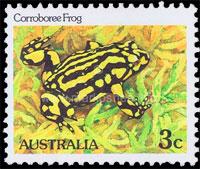
    1. Southern corroboree frog – Pseudophryne corroboree
    IUCN listing: Critically Endangered

    Inhabiting a small corridor on the New South Wales and Victorian border, the tiny southern corroboree frog – which is the size of a fingernail – is running on the edge of extinction. Fewer than 150 breeding males are thought to survive across 23 sites that were surveyed in 2001. The main suspected threat is the chytrid fungi. Although many studies have been undertaken, the success has been limited, as they have not been able to confirm the critical threat to the frogs. A studying conducted between 1997 and 1999 revealed that the frogs were present in 213 sites around the NSW and Victorian border but this number dropped only 79 sites as of 2001, revealing how quickly these animals were disappearing. A captive-breeding program, led by Sydney’s Taronga Zoo, reintroduced 800 eggs into Kosciuszko National Park in 2012.

    2. Margaret River burrowing crayfish – Engaewa pseudoreducta
    IUCN listing: Critically Endangered

    With only two known populations, the Margaret River burrowing crayfish is highly endangered. Even one of these may no longer exist, as there have been no sightings since 1985. The threats are almost all attributed to human activity. Land clearing is the biggest danger, as crayfish habitat can be eroded or contaminated by farming, mining and urban development. Feral pigs also damage habitat. No current population information exists but it is estimated that numbers are very low because of the restricted range of the species.

    3. Lord Howe Island phasmid – Dryococelus australis
    IUCN listing: Critically Endangered

    Once plentiful on Lord Howe Island, the phasmid came under serious threat in 1918 when black rats were introduced. They are now only found in the wild on Balls Pyramid, a rocky outcrop off the coast of the main island. In addition to the threat posed by rodents, the land lobster’s food source is also threatened. Morning glory, an invasive plant, competes with the land lobster’s only known source of food, the Melaleuca howeana. Plans to control these threats and introduce the species back to the mainland are projected to start in the next three years. A program at Melbourne Zoo has bred more than 9,000 of the insects in captivity, some of which have been returned to the wild.

    4. Bornemissza’s stag beetle – Hoplogonus bornemisszai
    EPBC listing: critically endangered

    Playing a key role in decomposing organic material, Bornemissza’s stag beetle is located in a highly specific area in north-eastern Tasmania. Growing to between 1.5 and 2.5cm long, these beetles are thought to numbers from several hundred to several thousand. Their larvae incubate underground and upon hatching, come to the surface and feeds with adults on the decaying organic material in the Tasmanian bushland. The beetle’s diet is the prime threat to existence: they require a thick layer of decomposing leaf matter. With the expansion of farmland and clear-cutting of Tasmanian forests, the beetle is under serious threat.

    5. Derwent River sea star – Marginaster littoralis
    EPBC listing: critically endangered

    Isolated to the chilly waters of the Derwent River estuary near Hobart, Tasmania, this sea star has been reduced to five known populations. While research on the sea star is sparse and the exact population size is not known, it has been reduced to very low levels and may already been wiped out. The greatest threat has been the introduction of the New Zealand sea star. At the beginning of the 20th century, oysters were shucked in the estuary and animals that were previously confined to New Zealand waters were introduced to Tasmania. No recovery plan for this species has been drafted as research on them is too sparse.

    6. Southern bent-wing bat – Miniopterus schreibersii bassanii
    EPBC listing: critically endangered

    The southern bent-wing bat hides in caves between Victoria and South Australia during the daylight hours and hunts after dark. The bat has been in decline for the last two decades, losing 67 per cent of its population in that time and numbering around 40,000 individuals. A recovery plan has been drafted by biologists to further determine causes of decline. The bats are particularly prominent in the Naracoorte caves, a nesting site where females return to give birth. Current threats include habitat loss to grazing land, pesticides, and disruption of roosting habits from humans.

    7. Orange-bellied parrot – Neophema chrysogaster
    IUCN listing: Critically Endangered

    Found predominantly darting through the Victorian and Tasmanian scrub, the orange-bellied parrot is highly endangered. This parrot has been in serious decline since the beginning of the 1900s, with fewer than 90 adults left in the wild. During the 1930s this bird was commonly found on both sides of the Bass Strait. Current threats are human related as its breeding and feeding habits occur almost entirely in small scrub, roughly a metre of the ground. This is the same vegetation that is often cleared for farm land and invaded by foreign plants. Living an average of just over two years, its reproductive cycle further inhibits the parrots ability to rebuild its population.

    8. Short-nosed sea snake – Aipysurus apraefrontalis
    IUCN listing: Critically Endangered

    Slithering through the waters of north-western Western Australia, the short-nosed sea snake has undergone serious population changes in the past several years. Once abundantly found hunting on reefs on the coast near Broome, the snake hasn’t been sighted on its common habitat on the Ashmore reef in any of the recent surveys since 2005. With a six-to-seven month gestation period, the snake is unlikely to breed more than once a year. Studies blame climate change for the decrease in numbers as the snake’s native waters are warming and causing changes to the ecosystem. Second to climate change is the effects of mining chemicals that are bleaching the reef and causing further detriment to the reefs.

    9. Red-finned blue-eye fish – Scaturiginichthys vermeilipinnis
    IUCN listing: Critically Endangered

    Making to the IUCN’s 100 most endangered species list, the red-finned blue-eye has shocked scientists with its ability to survive. Living exclusively around Edgbaston in central western Queensland, this tiny, brightly coloured fish has shown that it can live in some of the most extreme ecosystems over long periods of time. Expanding agricultural projects threatened the species at one point, but in 2008 the fish’s precious habitat was purchased by Bush Heritage Australia and is now protected. The main threat to the blue-eye is an invasive species, gambusia, a fish introduced to control mosquitoes but which spread with flooding. Gambusia’s population has exploded, endangering the blue-eye through competition for resources. The blue-eye’s current population is estimated at 2000-4000 individuals and needs to be intensively managed.

    10. Armoured mist frog – Litoria lorica
    IUCN listing: Critically Endangered

    The elusive and mysterious armoured mist frog is a species that baffled scientists with its decline in population. None of these frogs had been sighted after 1994 – until 2008 when a small population was discovered in northern Queensland living near the waterfall frog. Very little is known about the armoured mist frog and threats facing it. Its habitat has been protected since 1988 and corridors throughout possible migratory routes are still intact. One assumed threat has been chytrid fungal disease, which has killed amphibians around the world.

    Source: Australian Geographic, 4 October 2012
    http://www.australiangeographic.com.au/journal/australias-most-endangered-species.htm

  • Wildlife biologist Neil Dawe says he wouldn’t be surprised if the generation after him witnesses the extinction of humanity

    Wildlife biologist Neil Dawe says he wouldn’t be surprised if the generation after him witnesses the extinction of humanity

    All around him, even in a place as beautiful as the Little Qualicum River estuary, his office for 30 years as a biologist for the Canadian Wildlife Service, he sees the unravelling of “the web of life.” “It’s happening very quickly,” he says. Registered Professional Biologist Neil Dawe has written over 80 papers on birds, ecology and the environment. He received Environment Canada’s Regional Citation of Excellence Award for his work in co-founding and co-chairing the Brant Wildlife Festival. He received the Outstanding Service Award from the Federation of B.C. Naturalists and the Ian McTaggart-Cowan Award of Excellence in Biology from the Association of Professional Biologists of B.C. In 2006, he retired from the Canadian Wildlife Service, Environment Canada, after 31 years of managing National Wildlife Areas and Migratory Bird Sanctuaries on Vancouver Island. He is President of the Qualicum Institute: www.qualicuminstitute.ca.

    All around him, even in a place as beautiful as the Little Qualicum River estuary, his office for 30 years as a biologist for the Canadian Wildlife Service, he sees the unravelling of “the web of life.” “It’s happening very quickly,” he says. Registered Professional Biologist Neil Dawe has written over 80 papers on birds, ecology and the environment. He received Environment Canada’s Regional Citation of Excellence Award for his work in co-founding and co-chairing the Brant Wildlife Festival. He received the Outstanding Service Award from the Federation of B.C. Naturalists and the Ian McTaggart-Cowan Award of Excellence in Biology from the Association of Professional Biologists of B.C. In 2006, he retired from the Canadian Wildlife Service, Environment Canada, after 31 years of managing National Wildlife Areas and Migratory Bird Sanctuaries on Vancouver Island. He is President of the Qualicum Institute: www.qualicuminstitute.ca.

    A recent news report focussed on the precipitous decline of barn swallows on Vancouver Island. That is certainly true, says Dawe, who starting in 1978 worked on the Royal BC Museum’s four-volume Birds of British Columbia project, but it doesn’t tell the whole story. People will focus on the extinction of a species but not “the overall impact,” he says. When habitat diversity is lost, “it changes the whole dynamic. “The fork-tailed aerobatic wonders mate for life and year after year the couples, migrating from as far as South America, would return to the same nests in the old barn. However, their numbers began to decline as the area was developed. The trees were logged and milled, parts of the estuary were mined for gravel, rock walls were built to stop erosion, and a straight channel, in use to this day, was dug so the river no longer wound through the estuary, shifting course with the seasons. All that meant fewer insects and that meant weak and hungry barn swallows, now susceptible to the larvae of the blowfly. One by one, the nesting pairs slipped away over decades, Dawe says. “When I left there were none.”

    There are still barn swallows in the area but there aren’t as many: between 1966 and 2011, barn swallows in B.C. have declined at a rate of 4.96% a year. They’re among more 30 B.C. birds known to be in decline, including the iconic Great Blue Heron (1.7% per year), the Rufous Hummingbird (1.91%), the beautiful killdeer (3.8%), the American Goldfinch (4.85%) and so on. Forty-five of the 57 coastal waterbirds using the Strait of Georgia were in decline between 1999 and 2011, including the Brant sea goose (4.7% per year), Greater Yellowlegs (10.5%) and Western Grebe (16.4%).

    But it isn’t just birds. The inconspicuous Pacific crabapple, once a mainstay of the estuary, is all but gone. Dawe points to a scrawny metre-high specimen near a road. “I’d guess it’s a hundred years old,” he says. The Douglas fir and Sitka spruce are all but gone. The life-giving grassy carex, as Dawe and fellow biologist Andy Stewart reported in 2010, is being stripped from the estuary by resident Canada geese at a rate of 15-18 metric tonnes a year. “Most of these plants here now are invasive species,” he says.

    Indeed, in his 35 years of studying what is supposed to be a wildlife sanctuary, it has almost all changed, and it no longer supports the life it once did. It looks green and serene but to Dawe, “It’s a veritable desert here.” The loss to the food web is a loss to the web of life, he says, and people are a huge part of that web. Indeed, it’s an overabundance of people, perhaps by five-fold, which is driving resource extraction and consumption beyond a sustainable planet, he says.

    “Economic growth is the biggest destroyer of the ecology,” he says. “Those people who think you can have a growing economy and a healthy environment are wrong. “If we don’t reduce our numbers, nature will do it for us.” He isn’t hopeful humans will rise to the challenge and save themselves. “Everything is worse and we’re still doing the same things,” he says. “Because ecosystems are so resilient, they don’t exact immediate punishment on the stupid.”
    Source:
    http://www.oceansidestar.com/news/web-of-life-unravelling-wildlife-biologist-says-1.605499#sthash.OdE5LH3P.gbpl

  • Van drieëntwintig landen in Europa behoort Nederland tot de acht landen met het grootste aandeel bedreigde zoogdieren, vogels en vissen

    Van drieëntwintig landen in Europa behoort Nederland tot de acht landen met het grootste aandeel bedreigde zoogdieren, vogels en vissen

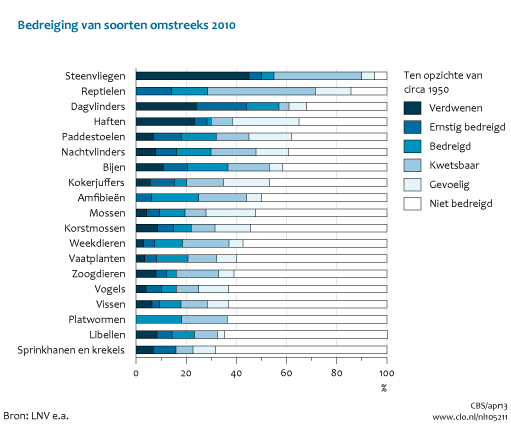
    Voor een groot aantal planten- en diergroepen zijn in Nederland Rode Lijsten van bedreigde soorten opgesteld. Daaruit komt naar voren dat bij alle soortgroepen meer dan éénderde van alle soorten van de soortgroep bedreigd is. Bij reptielen, steenvliegen en dagvlinders staan zelfs meer dan tweederde van de soorten op de Rode Lijst. Bij dagvlinders, steenvliegen, haften en bijen zijn relatief veel soorten geheel uit Nederland verdwenen. Van drieëntwintig landen in Europa behoort Nederland tot de acht landen met het grootste aandeel bedreigde zoogdieren, vogels en vissen. Met name de noordelijke landen van Europa hebben relatief het kleinste aantal bedreigde soorten. Nederland neemt wat betreft het totale aantal zoogdieren, vogels, reptielen, amfibieën en vissen dat met uitsterven bedreigd wordt binnen een Europa een middenpositie in.

    Voor een groot aantal planten- en diergroepen zijn in Nederland Rode Lijsten van bedreigde soorten opgesteld. Daaruit komt naar voren dat bij alle soortgroepen meer dan éénderde van alle soorten van de soortgroep bedreigd is. Bij reptielen, steenvliegen en dagvlinders staan zelfs meer dan tweederde van de soorten op de Rode Lijst. Bij dagvlinders, steenvliegen, haften en bijen zijn relatief veel soorten geheel uit Nederland verdwenen. Van drieëntwintig landen in Europa behoort Nederland tot de acht landen met het grootste aandeel bedreigde zoogdieren, vogels en vissen. Met name de noordelijke landen van Europa hebben relatief het kleinste aantal bedreigde soorten. Nederland neemt wat betreft het totale aantal zoogdieren, vogels, reptielen, amfibieën en vissen dat met uitsterven bedreigd wordt binnen een Europa een middenpositie in.

    Bron: Compendium voor de Leefomgeving
    http://www.compendiumvoordeleefomgeving.nl/indicatoren/nl1052-Aantal-bedreigde-planten–en-diersoorten.html?i=33-109

  • Der Schlüssel zur Erhaltung der Biodiversität liegt in der Förderung der ökologischen Landwirtschaft auf breiter Ebene

    Der Schlüssel zur Erhaltung der Biodiversität liegt in der Förderung der ökologischen Landwirtschaft auf breiter Ebene

    Rund um den Globus werden in der konventionell betriebenen Landwirtschaft gigantische Mengen an Pestiziden ausgebracht. Die Folgen für die Umwelt sind gravierend. Wissenschaftler zählen den maßlosen Einsatz toxischer Pflanzenschutzmittel als eine signifikante Ursache für das besorgniserregende Bienensterben und den drastischen Rückgang zahlreicher Amphibienarten, ebenso den in Windeseile stattfindenden generellen weltweiten Rückgang der biologischen Vielfalt. Das Fehlen von Insekten in der Natur hat weitreichende negative Konsequenzen. Denn Insekten sind wichtige Nahrungsquellen für viele Tiere, beispielsweise für Igel und Vögel, deren Bestände kontinuierlich rückläufig sind. Der Schlüssel zur Erhaltung und Unterstützung der Biodiversität liegt folglich in der Förderung der ökologischen Landwirtschaft auf breiter Ebene. Im Bioanbau finden derart umweltschädigende Pflanzenschutzmittel keinerlei Anwendung, denn hier sind toxische Pestizide und Herbizide tabu.

    Rund um den Globus werden in der konventionell betriebenen Landwirtschaft gigantische Mengen an Pestiziden ausgebracht. Die Folgen für die Umwelt sind gravierend. Wissenschaftler zählen den maßlosen Einsatz toxischer Pflanzenschutzmittel als eine signifikante Ursache für das besorgniserregende Bienensterben und den drastischen Rückgang zahlreicher Amphibienarten, ebenso den in Windeseile stattfindenden generellen weltweiten Rückgang der biologischen Vielfalt. Das Fehlen von Insekten in der Natur hat weitreichende negative Konsequenzen. Denn Insekten sind wichtige Nahrungsquellen für viele Tiere, beispielsweise für Igel und Vögel, deren Bestände kontinuierlich rückläufig sind. Der Schlüssel zur Erhaltung und Unterstützung der Biodiversität liegt folglich in der Förderung der ökologischen Landwirtschaft auf breiter Ebene. Im Bioanbau finden derart umweltschädigende Pflanzenschutzmittel keinerlei Anwendung, denn hier sind toxische Pestizide und Herbizide tabu.

    Beispielsweise siedeln sich bei reduzierter Anwendung von Pestiziden wieder vielfältige Wildblumenarten in der Natur an. Wildblumen spenden wiederum Bienen und zahlreichen Insekten mit ihrem süßen Nektar die zum Überleben dringend benötigte Nahrung. Ein Zuwachs an Bienen sorgt in der Landwirtschaft auf ganz natürliche Art und Weise für höhere Ernteerträge. Zudem halten vielfältige Nützlinge zahlreiche Schädlinge im Zaum, was folglich den Einsatz von Pflanzenschutzmitteln reduzieren würde. Demzufolge könnten sich durch die Förderung der ökologischen Landwirtschaft auch die Vogelpopulationen langsam wieder erholen. Hinzu kommt, dass die Böden in der biologischen Landwirtschaft weitaus gesünder sind, was auf natürlichem Weg robustere Pflanzen mit höheren Erträgen hervorbringt.

    Quelle: Gartenelfen, 08.08.2013
    http://www.gartenelfen.de/artenvielfalt-2.html

  • Agricultural pesticide use has contributed significantly to the decline of imperiled species in Canada

    Agricultural pesticide use has contributed significantly to the decline of imperiled species in Canada

    Humans are modifying the global landscape at an unprecedented scale and pace. As a result, species are declining and going extinct at an alarming rate. I examined patterns of species’ declines in three different groups in relation to a number of anthropogenic variables. I found high losses of Canadian imperiled bird, mammal, amphibian and reptile species in regions with high proportions of agricultural land cover. However, losses of imperiled species are significantly more strongly related to the proportion of the region treated with agricultural pesticides. This is consistent with the hypothesis that agricultural pesticide use, or something strongly collinear with it (perhaps intensive agriculture more generally), has contributed significantly to the decline of imperiled species.

    Humans are modifying the global landscape at an unprecedented scale and pace. As a result, species are declining and going extinct at an alarming rate. I examined patterns of species’ declines in three different groups in relation to a number of anthropogenic variables. I found high losses of Canadian imperiled bird, mammal, amphibian and reptile species in regions with high proportions of agricultural land cover. However, losses of imperiled species are significantly more strongly related to the proportion of the region treated with agricultural pesticides. This is consistent with the hypothesis that agricultural pesticide use, or something strongly collinear with it (perhaps intensive agriculture more generally), has contributed significantly to the decline of imperiled species.

    Source:
    Mary Katherine Elizabeth Gibbs (2012) Thesis submitted to the Faculty of Graduate and Postdoctoral Studies in partial fulfillment of the requirements for the PhD degree in the Ottawa-Carleton Institute of Biology (attached)

  • Conservationists in despair: all mainstream parties are unwilling to see economic growth compromised by a concern for nature

    Conservationists in despair: all mainstream parties are unwilling to see economic growth compromised by a concern for nature

    The State of Nature, a report published in May by a coalition of environmental charities, found that more than half our wildlife species are in decline. “We are heading for Armageddon in terms of nature. We are faced with a nightmare of no nature in large parts of southern England,” says Mark Cocker, author of Birds and People, a monumental new account of the role birds play in human life. “The filigree of our lives, the things that make it fantastic – silver-washed fritillaries, nightingales, dunlin, water voles chomping away at the edge of the pool – are disappearing. We are faced with the most appalling loss.” Cocker’s passion echoes a rollickingly fierce speech to the Welsh assembly earlier this summer by Iolo Williams, the RSPB officer turned Springwatch presenter, which is still being passed around and debated among naturalists. In it, Williams recalled his childhood by the Vyrnwy river, currently imperilled by proposals for pylons and infrastructure to service vast wind farms. The Mid Wales countryside may still appear glorious but, according to Williams, it is bereft: water voles, trout, curlew and cuckoos are gone; so, too, are insects and hay meadows (Wales has lost 99% of its hay meadows since the second world war). On the moors, alien conifers have been planted. “It’s like going and looking at war graves. Every single tree is a death-knell, a nail in the coffin of that moor,” said Williams. “We really are on the brink of disaster.”

    The State of Nature, a report published in May by a coalition of environmental charities, found that more than half our wildlife species are in decline. “We are heading for Armageddon in terms of nature. We are faced with a nightmare of no nature in large parts of southern England,” says Mark Cocker, author of Birds and People, a monumental new account of the role birds play in human life. “The filigree of our lives, the things that make it fantastic – silver-washed fritillaries, nightingales, dunlin, water voles chomping away at the edge of the pool – are disappearing. We are faced with the most appalling loss.” Cocker’s passion echoes a rollickingly fierce speech to the Welsh assembly earlier this summer by Iolo Williams, the RSPB officer turned Springwatch presenter, which is still being passed around and debated among naturalists. In it, Williams recalled his childhood by the Vyrnwy river, currently imperilled by proposals for pylons and infrastructure to service vast wind farms. The Mid Wales countryside may still appear glorious but, according to Williams, it is bereft: water voles, trout, curlew and cuckoos are gone; so, too, are insects and hay meadows (Wales has lost 99% of its hay meadows since the second world war). On the moors, alien conifers have been planted. “It’s like going and looking at war graves. Every single tree is a death-knell, a nail in the coffin of that moor,” said Williams. “We really are on the brink of disaster.”

    Source: The Guardian, 10 August 2013
    http://www.theguardian.com/environment/2013/aug/10/britains-changing-countryside-conservation

  • Australia has experienced the largest documented decline in biodiversity of any continent over the past 200 years

    Australia has experienced the largest documented decline in biodiversity of any continent over the past 200 years

    Under the EPBC Act more than 50 species of Australian animals have been listed as extinct, including 27 mammal species, 23 bird species, and 4 frog species. The number of known extinct Australian plants is 48. Australia’s rate of species decline continues to be among the world’s highest, and is the highest in the OECD.
    The list of nationally threatened species continues to grow in Australia, with 426 animal species (including presumed extinctions) and 1,339 plant species listed as threatened under the EPBC Act. Furthermore, there is some evidence that the rates of recovery once a species has been listed as threatened, whilst it is difficult to determine in short time periods, may be particularly low. In a study conducted on 38 threatened species recovery plans across every state and territory, evidence of ongoing decline in populations was displayed in 37 per cent of cases.

    Under the EPBC Act more than 50 species of Australian animals have been listed as extinct, including 27 mammal species, 23 bird species, and 4 frog species. The number of known extinct Australian plants is 48. Australia’s rate of species decline continues to be among the world’s highest, and is the highest in the OECD.
    The list of nationally threatened species continues to grow in Australia, with 426 animal species (including presumed extinctions) and 1,339 plant species listed as threatened under the EPBC Act. Furthermore, there is some evidence that the rates of recovery once a species has been listed as threatened, whilst it is difficult to determine in short time periods, may be particularly low. In a study conducted on 38 threatened species recovery plans across every state and territory, evidence of ongoing decline in populations was displayed in 37 per cent of cases.

    Source:
    Bimbleboxartproject, 10 August 2013
    http://bimbleboxartproject.wordpress.com/2013/08/10/how-to-tell-the-wildlife-that-people-are-planning-to-come-and-destroy-their-thriving-ancient-ecosystems-why-does-australia-have-such-a-high-rate-of-biodiversity-loss/