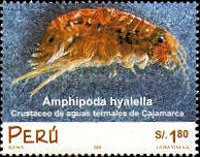
Two species, the fathead minnow Pimephales promelas and the amphipod Hyalella azteca, were tested to examine acute toxicity to two insecticides, cyfluthrin and imidacloprid individually and as a mixture. Cyfluthrin was acutely toxic to P. promelas and H. azteca with EC50 values and 95 % confidence intervals of 0.31 µg L−1 (0.26–0.35 µg L−1) and 0.0015 µg L−1 (0.0011–0.0018 µg L−1), respectively. Imidacloprid was not acutely toxic to P. promelas at water concentrations ranging from 1 to 5000 µg L−1, whereas it was toxic to H. azteca with a EC50 value of 33.5 µg L−1 (23.3–47.4 µg L−1). For the P. promelas mixture test, imidacloprid was added at a single concentration to a geometric series of cyfluthrin concentrations bracketing the EC50 value. A synergistic ratio (SR) of 1.9 was found for P. promelas, which was calculated using the cyfluthrin-only exposure and mixture-exposure data. Because cyfluthrin and imidacloprid were toxic to H. azteca, the mixture test was designed based on an equipotent toxic unit method. Results from the mixture test indicated a model deviation ratio (MDR) of 1.7 or 2.7 depending on the model. Mixture test results from the simultaneous exposure to cyfluthrin and imidacloprid with both species indicated a greater than expected toxic response because the SR or MDR values were >1. Because these two insecticides are commonly used together in the same product formulations, nontarget species could be more affected due to their greater-than-additive toxicity observed in the current study.
Two species, the fathead minnow Pimephales promelas and the amphipod Hyalella azteca, were tested to examine acute toxicity to two insecticides, cyfluthrin and imidacloprid individually and as a mixture. Cyfluthrin was acutely toxic to P. promelas and H. azteca with EC50 values and 95 % confidence intervals of 0.31 µg L−1 (0.26–0.35 µg L−1) and 0.0015 µg L−1 (0.0011–0.0018 µg L−1), respectively. Imidacloprid was not acutely toxic to P. promelas at water concentrations ranging from 1 to 5000 µg L−1, whereas it was toxic to H. azteca with a EC50 value of 33.5 µg L−1 (23.3–47.4 µg L−1). For the P. promelas mixture test, imidacloprid was added at a single concentration to a geometric series of cyfluthrin concentrations bracketing the EC50 value. A synergistic ratio (SR) of 1.9 was found for P. promelas, which was calculated using the cyfluthrin-only exposure and mixture-exposure data. Because cyfluthrin and imidacloprid were toxic to H. azteca, the mixture test was designed based on an equipotent toxic unit method. Results from the mixture test indicated a model deviation ratio (MDR) of 1.7 or 2.7 depending on the model. Mixture test results from the simultaneous exposure to cyfluthrin and imidacloprid with both species indicated a greater than expected toxic response because the SR or MDR values were >1. Because these two insecticides are commonly used together in the same product formulations, nontarget species could be more affected due to their greater-than-additive toxicity observed in the current study.
Source:
Michelle Lanteigne, Sara A. Whiting, Michael J. Lydy.
Archives of Environmental Contamination and Toxicology
February 2015, Volume 68, Issue 2, pp 354-361