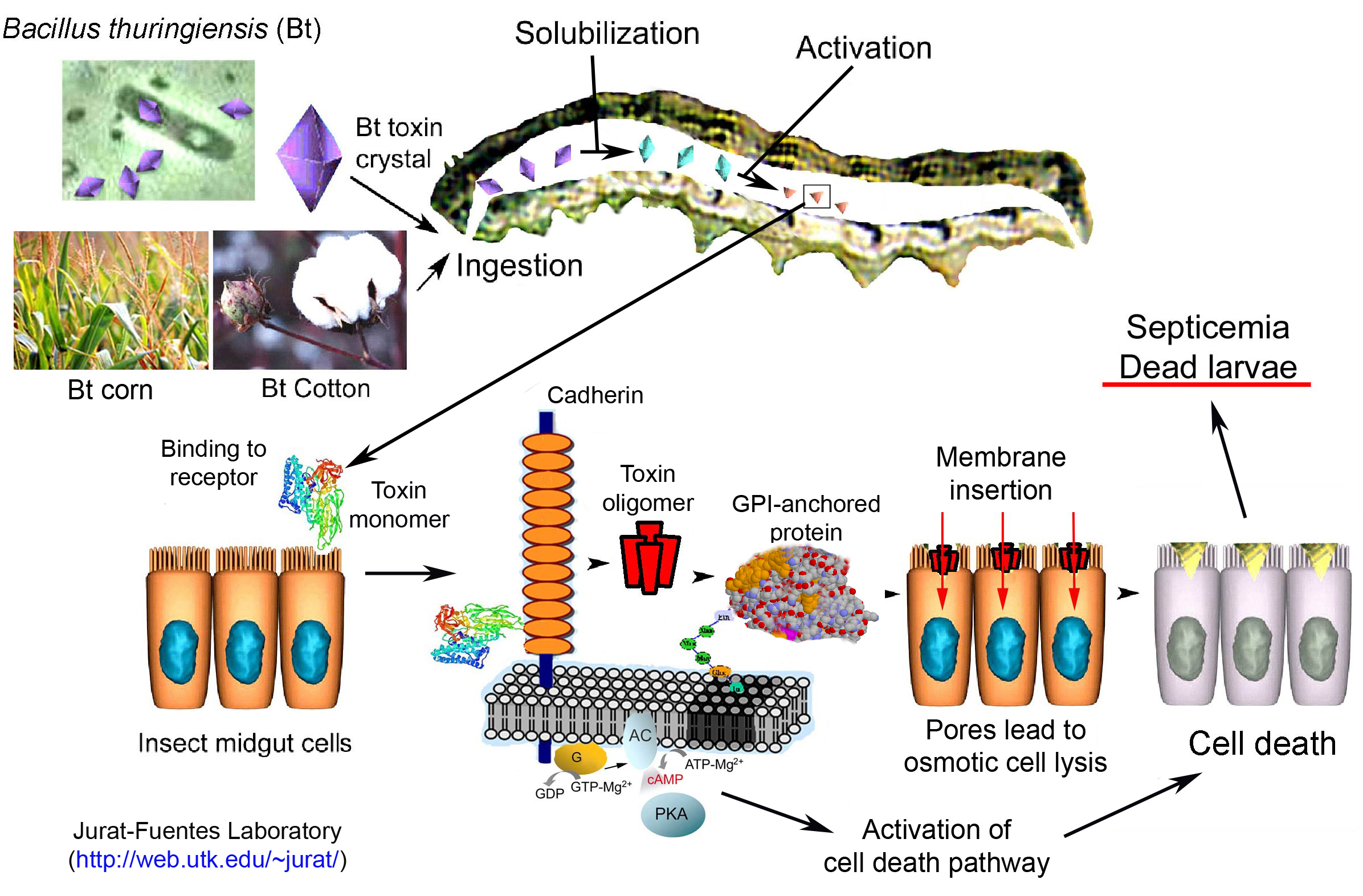
To examine the binding of Bacillus thuringiensis δ-endotoxins, CryIAa, CryIAb, and CryIAc, to Lymantria dispar (gypsy moth) brush border membrane vesicles (BBMV), saturation kinetic analyses were conducted according to a two-step interaction scheme for δ-endotoxin binding to BBMV, rather than the one-step reversible binding presented in prior reports. So far, all published binding studies known to us have used the Scatchard equation or the Hill equation, which analyzes binding parameters assuming a one-step reversible interaction (Reaction 1): BS + T ↔ BS*T. Here BS is the binding site on the membrane, T is the toxin, and BS*T is the dissociable complex formed by binding site and toxin. However, a large body of evidence indicates that the binding between toxin and BBMV quickly becomes irreversible. A two-step interaction would describe toxin-BBMV interaction better than Reaction 1: BS + T ↔ BS*T→ BS-T (reaction 2). Here BS-T is the toxin irreversibly bound to the membrane. The order of toxicity of the δ-endotoxins, as measured by the dose required for a 50% inhibition of weight gain (ID50), was CryIAa (77.3 ng) > CryIAb (157 ng) > CryIAc (187 ng). While both the maximum extent of binding, Bmax, and the half-maximum insertion rate concentration, K1/2, was observed to be indirectly related to toxicity, the rate constant of irreversible binding, k2, was found to be directly correlated to toxicity.
Source:
Yizhi Liang, Smita S. Patel and Donald H. Dean. THE JOURNAL OF BIOLOGICAL CHEMISTRY Vol. 270, No. 42, Issue of October 20, pp. 24719 –24724, 1995
Irreversible Binding Kinetics of Bacillus thuringiensis CryIA δ-Endotoxins to Gypsy Moth Brush Border Membrane Vesicles Is Directly Correlated to Toxicity